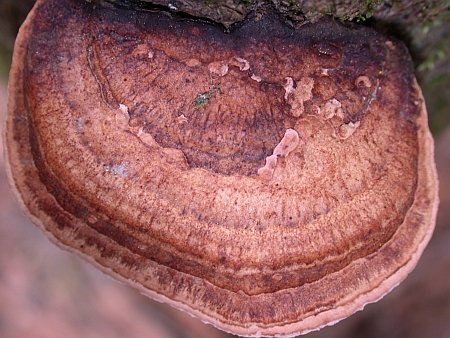
A look at the upper surface of the sessile polypore Fomitopsis cajanderi(P. Karst) Kotl. & Pouzar., commonly known as the “rosy conk”.
Classification
Kingdom Fungi
Phylum Basidiomycota
Class Basidiomycetes
Order Polyporales
Family Fomitopsidaceae
Genus Fomitopsis
Synonyms
Fomes cajanderi P. Karst.
Finl. Basidsvamp. 46(11): 8 (1904) [1903-1904]
Fomes subroseus (Weir) Overh.
Bulletin of the Penn. State College 316: 11 (1935)
Fomitopsis roseozonata (Lloyd) S. Ito
Mycol. Fl. Japan 2(4): 309 (1955)
Fomitopsis subrosea (Weir) Bondartsev & Singer
Annls mycol. 39(1): 55 (1941)
Polystictus mimicus (P. Karst.) Sacc. & Trotter
Syll. fung. (Abellini) 21: 322 (1912)
Pycnoporus mimicus P. Karst.
Trudy Troitsk. Otd. imp. russk. geogr. obsc. 8: 62 (1906)
Trametes roseozonata Lloyd
Mycol. Writ. 7: 1144 (1922)
Trametes subrosea Weir
Rhodora 25: 217 (1923)
Ungulina subrosea (Weir) Murashk.
Trudy omsk. sel’sk Chozj. Kirova 17: 86 (1939)
Common name
Rosy conk
My name is Austin Collins.
I've dedicated my life to Mushrooms.
I believe Mushrooms are the best kept secret when it comes to health and well being.
For that reason, I would like to share a company with you that in my opinion makes the best mushroom products on the market.
The company is called Noomadic Herbals, my favorite supplement they make is called "Mushroom Total".
I take their products every day and they have helped me think better and have more energy. Give them a try.
-Austin
Description
This fungus is the causative agent of a tree disease called “brown top rot”. As early as 1926, Zeller identified this fungus as the organism largely responsible for large economic losses resulting from damage to peach and prune trees in orchards from central California to British Columbia (Zeller, 1926). In the early stages of decay, the wood develops a faint brownish or yellow-brown stain, while more advanced stages of decay appear as soft, irregular, yellowish or reddish-brown cubes. Thin, white or faintly rose-colored mycelial felts may develop in the cracks between the cubes. In both the natural environment and in culture the vegetative mycelium of F. cajanderi forms a primordial mat, a basidiocarp primordium and a sporulating basidiocarp. The fundamental structural unit is the same in both laboratory culture and in nature: the clamped, generative hypha functions initially in nutrient absorption, then produces unbranched or branched skeletal cells and basidia, and later develops irregularly thickened walls and swollen clamp connections (Kennedy and Wong, 1978).
Fruiting bodies: 2-10 cm in diameter, perennial, woody, and bracket or hoof-shaped, typically glabrous; often found in overlapping clusters, upper surface typically rough and brown or black in color, often; the sterile border is rounded and blunt.
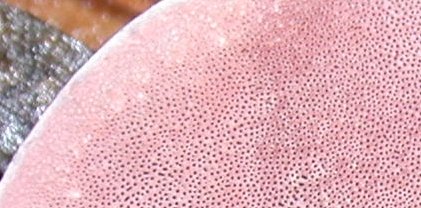
Pore surface: rose-colored, sometimes with greenish-brown zone lines, pores are thick-walled and shallow, 3-5 pores/mm; flesh concolorous with pore surface.
Spores: smooth, allantoid, 5.5-7.0 x 1.5-2.0 µm.
Spore print: off-white.
Habitat: found on conifer wood (or “broad-leaved trees” in China, see He et al., 2003; 2006)
Distribution: widespread.
Odor and taste: not distinguishable.
Edibility: inedible.
Bioactive compounds
A study of secondary metabolites from F. cajanderi led to the isolation of three novel acetal lactones named fomlactones A, B, and C from the neutral ether extracts (He et al., 2003).
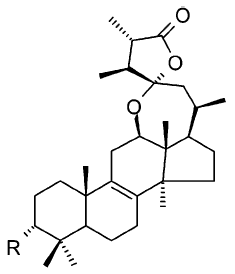
Later work by the same research group (He et al., 2006) revealed additional compounds including:
- ergosterol
- ergosterol peroxide
- ergosta-4,6,8 (14),22-tetraen-3-one
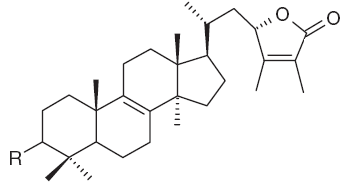
- 16-acetoxy-24-methylene- 3-oxolanosta-8-en-21-oic acid (R= ═O)
- the novel lanostane-type triterpenoid 24-methyl- lanost-8,24-dien- 23S,26-lactone
- methyl 24-methylene-3-oxolanost-8-en-26-oic ester

24-methyl-lanost-8,24-dien-23S,26-lactone from the mushroom Fomitopsis cajanderi - 3β-acetoxy-24-methylene- 8-en-26-oic ester
- methyl 3α-acetoxy-24-methylene 23-oxylanost-8-en-26-oic ester
References
He J, Feng XZ, Lu Y, Zhao B.
Fomlactones A-C, novel triterpene sactones from Fomes cajanderi.
J Nat Prod. 2003 66(9):1249-51.
He J, Feng XZ, Ji TF, Lu Y, Zhao B.
Secondary metabolites from fungus Fomes cajanderi.
Nat Prod Res. 2006 20(6):598-605.
Hogberg N, Hermansson JO.
Fomitopsis cajanderi in Europe – Evidence from mating experiments.
Mycotaxon. 1999 70:69-71.
Kennedy LL, Wong WM.
Fomitopsis cajanderi – development in nature and in culture.
Can J Bot. 1978 56(19):2319-27.
Madhosin C.
A serological comparison of isolates of Fomes roseus and Fomes subroseus.
Can J Bot. 1964 42(12):1677&.
Tsuneda I, Kennedy LL.
Basidiospore germination and substrate preference in Fomes fomentarius and Fomitopsis cajanderi.
Mycologia 1980. 72(1):204-8.
Zeller SM.
The brown-pocket heart rot of stone-fruit trees caused by Trametes subrosea Weir.
J Agric Res. 1926 33:687-93.