

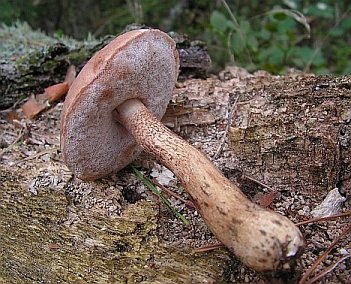
Tylopilus felleus (Bull.) P. Karst., the bitter bolete.
Synonyms
Boletus alutarius Fr.
Boletus alutarius Rostk.
Boletus felleus Bull.
Tylopilus alutarius (Fr.) Rea
Tylopilus felleus var. alutarius (Fr.) P. Karst.
Tylopilus felleus (Bull.) P. Karst., Revue mycol.
Tylopilus felleus var. minor (Coker & Beers) Pilát & Dermek
Tylopilus felleus var. uliginosus A.H. Sm. & Thiers
Common name
Bitter bolete
Description
Cap: 5-15 cm; convex to broadly convex or nearly flat in age; dry; smooth, unpolished; sometimes becoming cracked; brown to tan, usually with cinnamon shades, becoming paler with age. Pore surface salmon to flesh-colored; sometimes bruising brownish; pores circular, 1-2 per mm; tubes to 2 cm.
Stem: 4-20 cm long; 1-3 cm thick (above the base); often curved; club-shaped and bulbous; pale above, concolorous with cap downward; strongly reticulate, at least over upper third; sometimes with olive stains in age.
Flesh: thick and white; unchanging or staining pinkish.
Spore print: flesh colored to clay-pink.
Spores: 11-17 x 3-5 µm; spindle-shaped to elliptical; smooth.
Habitat: coniferous and deciduous woodland. Season late summer to autumn. Solitary, or sometimes small groups.
Edibility: inedible due to its extremely bitter taste.
Chemical reactions: cap surface orange to reddish orange with KOH or ammonia, olive with iron salts; flesh greenish yellow with KOH, pale yellow (with a bluish zone) with ammonia; grayish green with iron salts. Siderophilous granulation is a characteristic of this species.
Details about the distinguishing microscopic characteristics of this and other Tylopilus species are given in Wolfe (1991).
My name is Austin Collins.
I've dedicated my life to Mushrooms.
I believe Mushrooms are the best kept secret when it comes to health and well being.
For that reason, I would like to share a company with you that in my opinion makes the best mushroom products on the market.
The company is called Noomadic Herbals, my favorite supplement they make is called "Mushroom Total".
I take their products every day and they have helped me think better and have more energy. Give them a try.
-Austin
Medicinal effects
Anti-tumor activity
Polysaccharides extracted from the mycelial culture of T. felleus and administered intraperitoneally into white mice at a dosage of 300 mg/kg inhibited the growth of Sarcoma 180 and Ehrlich solid cancers by 100% (Ohtsuka et al., 1973).
Another mouse study evaluated the antitumor activity of tylopilan, a β-(1→3) (1→6) linked glucan isolated from fruit bodies in combination with a Propionibacterium acnes preparation (known to be immunogenic). A single injection of tylopilan (25 or 50 µg per mouse) was sufficient to extend the mean survival time of mice injected with tumor cells from 17.5 to 22.8 days. Tylopilan injected in conjunction with the immunostimulative Propionibacterium acnes preparation prolonged significantly MST in comparison to control mice as well as to tylopilan alone treated mice suggesting that the immune stimulation enhances the antitumor effect of tylopilan. Additionally, tylopilan showed cytotoxic activity towards 180-TG Crocker tumor cells in vitro at a variety of concentrations ranging from 37.5 to 300 µg/ml (Grzbek et al., 1994).
Antiinflammatory activity
T. felleus lyophilized preparation tested in the carrageenin-induced oedema test in rats, exhibit a significant inhibition of inflammation at all doses above 50 mg/kg (subcutaneous) while oral administration produced no significant results (Kohlmunzer et al., 1977)
Web
Mushroom Expert
There’s a variety of pictures at this Czech nature photography site, some more at the and BioPix site.
References
Chlap Z, Kohlmunzer S.
Effect of Tylopilus felleus preparation on transplantable tumors in mice.
Planta Medica. 1978 33(3):290-1.
Defaye J, Kohlmunzer S, Sodzawiczny K, Wong E.
Structure of an antitumor, water-soluble D-glucan from the carpophores of Tylopilus felleus.
Carbohydrate Research. 1988 173(2):316-23.
Grzybek J, Zgorniaknowosielska I, Kasprowicz A, Zawilinska B, Kohlmunzer S.
Antitumor activity of a fungal glucan tylopilan and Propionibacterium acnes preparation.
Acta Societatis Botanicorum Poloniae. 1994 63(3-4):293-8.
Kohlmunzer S, Grzybek J, Molik-Wegiel J.
Investigations on the biological activity of extracts of Tylopilus felleus (Bull. ex Fr.) P Karst. by means of mycological tests.
Pol J Pharmacol Pharm. 1975 27(1):95-9.
Kohlmunzer S, Grzybek J, Tanaka M.
Anti-tumor and cyto-toxic activity of polysaccharides from Tylopilus felleus.
Planta Medica. 1980 39(3):231-2.
Kohlmunzer S, Quinn ML, Benoit PS, Farnsworth NR.
Antiinflammatory activity of Tylopilus felleus (Bull. ex Fr.) P. Karst.
Pol J Pharmacol Pharm. 1977 29(5):539-41.
McLaughlin DJ.
Fruitbody formation by Tylopilus felleus in axenic culture.
Mycologia. 1974 66(1):197-202.
Ohtsuka S, Ueno S, Yoshikumi C, Hirose F, Ohmura Y, Wada T, Fujii T, Takahashi E.
Polysaccharides having an anticarcinogenic effect and a method of producing them from species of Basidiomycetes.
UK Patent 1331513, 26 September 1973.
Wolfe CB.
Type studies in Tylopilus (Boletaceae). V. Taxa described by Alexander H. Smith, Harry D. Thiers, and Samuel J. Mazzer.
Can J Bot. 1991 69(8):1833-8.
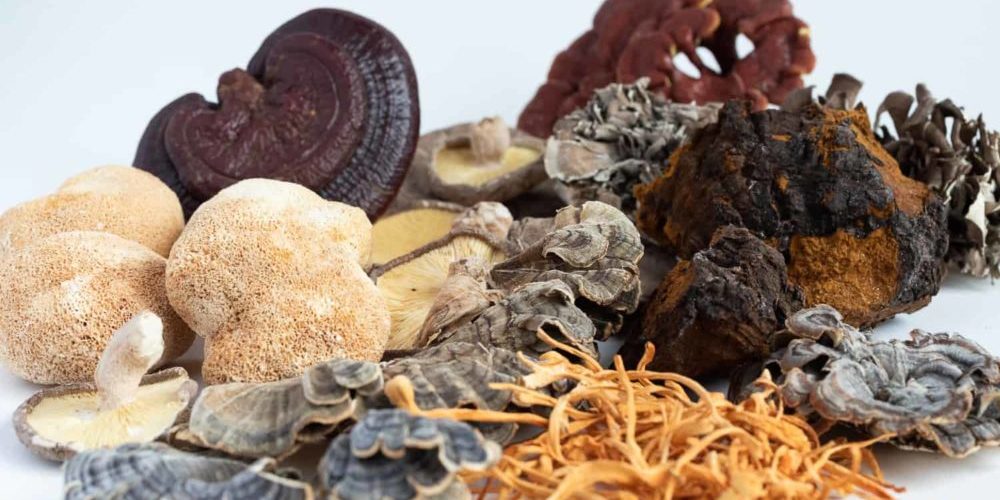

What is the best way to use this mushroom as medicine? Dried and in food? Fresh, as food? In a tincture or decoction?