
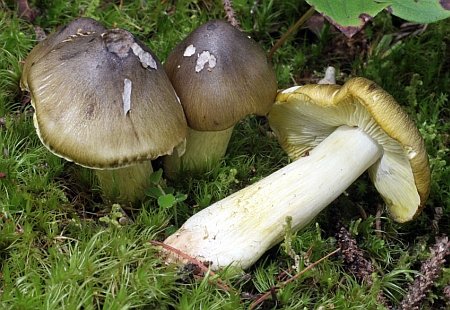
The deceiving knight, Tricholoma sejunctum (Sowerby) Quél. Note the characteristic dark fibrils emanating radially from the center of the cap, and the yellowish tinge of the gills near the margin.
Synonyms
Agaricus sejunctus Sowerby
Coloured Figures of English Fungi … 2: tab. 126 (1799) [1798-99]
Melanoleuca sejuncta (Sowerby) Murrill
N. Amer. Fl. (New York) 10(1): 25 (1914)
Common names
Deceiving knight
Braungelber Ritterling (German)
Streephoedridderzwam (Dutch)
Description
Cap: 3-9 cm diameter, conical to convex when young, expanding to plano-convex with large, broad umbo, with deflexed to more or less straight margin, yellow or greenish yellow, surface slightly viscid when moist, fibrillose with dark fibrils, especially at center, at margin sometimes with some fibrillose–squamulose remnants of veil.
Gills: fairly close, adnate to emarginate, segmentiform to ventricose, white to grayish-pink initially, becoming yellow near cap margin; entire to eroded, concolorous edge.
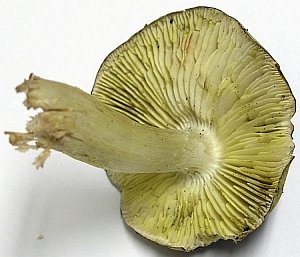
Stem: 7-13 cm tall x 0.8-2.5 cm thick, cylindrical to subclavate, often with pointed, tapering base, white at apex, towards base with yellow tinge, at very base sometimes with pinkish-reddish tinge, pruinose–scurfy at apex, strongly fibrillose/striate below; context white.
Odor: strongly farinaceous/fruity.
Taste: strongly farinaceous with bitter aftertaste.
Edibility: inedible, possible gastrointestinal irritant.
Spore print: white.
Spores: subglobose to ellipsoid with pronounced hilar appendage, smooth, inamyloid, 6-7.5 x 4.5-6 µm.
Habitat: single or in small groups, ectomycorrhizal, associated with Quercus or Fagus; late summer and fall.
Description adapted from Bas et al., 1990, p. 114
Medicinal properties
Antitumor effects
Polysaccharides extracted from the mycelial culture of T. sejunctum and administered intraperitoneally into white mice at a dosage of 300 mg/kg inhibited the growth of both Sarcoma 180 and Ehrlich solid cancers by 90%, respectively (Ohtsuka et al., 1973).
My name is Austin Collins.
I've dedicated my life to Mushrooms.
I believe Mushrooms are the best kept secret when it comes to health and well being.
For that reason, I would like to share a company with you that in my opinion makes the best mushroom products on the market.
The company is called Noomadic Herbals, my favorite supplement they make is called "Mushroom Total".
I take their products every day and they have helped me think better and have more energy. Give them a try.
-Austin
Links
References
Bas C, Kuyper TW, Noordeloos ME, Vellinga EC. (1990).
Flora Agaricina Neerlandica: Critical Monographs on Families of Agarics and Boleti Occurring in the Netherlands. Vol 2.
Balkema, Rotterdam, Brookfield. 144 pp.
Ohtsuka S, Ueno S, Yoshikumi C, Hirose F, Ohmura Y, Wada T, Fujii T, Takahashi E.
Polysaccharides having an anticarcinogenic effect and a method of producing them from species of Basidiomycetes.
UK Patent 1331513, 26 September 1973.