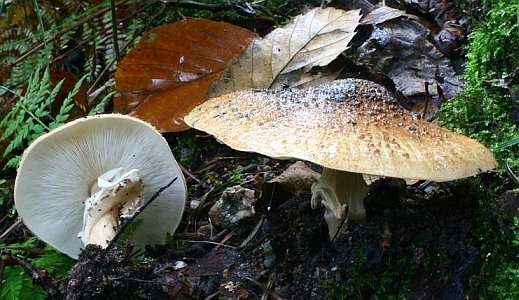
The medicinal mushroom Lepiota aspera.
Common name
Freckled dapperling
Synonyms
Agaricus acutesquamosus Weinm.
Agaricus asper Pers.
Agaricus elvensis Berk. & Broome
Agaricus friesii Lasch
Agaricus friesii subsp. acutesquamosus (Weinm.) Fr.
Agaricus mariae Klotzsch
Amanita aspera (Pers.) Pers.
Amanita rubens f. aspera (Fr.) Veselý
Amplariella aspera (Vittad.) E.-J. Gilbert
Cystolepiota acutesquamosa (Weinm.) Bon
Cystolepiota aspera (Pers.) Bon
Cystolepiota friesii (Lasch) Bon
Echinoderma acutesquamosum (Weinm.) Bon
Echinoderma asperum (Pers.) Bon
Echinoderma friesii (Lasch) Bon
Lepiota acutesquamosa (Weinm.) P. Kumm.
Lepiota acutesquamosa var. furcata Kühner
Lepiota aspera var. acutesquamosa (Weinm.) Singer
Lepiota friesii (Lasch) Quél., Mém. Soc. Émul. Montbéliard
Lepiota friesii var. acutesquamosa (Weinm.) Quél.
Description
Cap: 3–11 cm wide, at first convex, becoming plane, sometimes with a central knob; disc with brown fibrous scales and dark pointed warts, warts deciduous and tufts of dark fibers remain in their scars; margin like the disc.
Gills: free, white, crowded, sometimes forked, edges usually eroded.
Spore print: white.
Stem: 6–11 cm long, top 8–12 mm thick; slightly club-shaped or bulbous; stuffed or hollow; silky smooth above, brown fibrous below; sometimes with dark pointed warts at the base.
Ring: membranous to cobwebby; usually persistent when membranous, not movable, sometimes with dark pointed warts at the margin.
Habitat: solitary to scattered on rich soil, humus, forest debris.
Edibility: edible with caution.
Spores: 6.5–9 (11) × 2–3.5 µm, oblong, without a germ pore, hyaline to pale yellow in Melzer’s.
Medicinal properties
Antitumor effects
Polysaccharides extracted from the mycelial culture of L. aspera and administered intraperitoneally into white mice at a dosage of 300 mg/kg inhibited the growth of Sarcoma 180 and Ehrlich solid cancers by 70% (Ohtsuka et al., 1973).
A dichloromethane extract of Lepiota aspera was shown to be antibacterial towards Escherichia coli and Bacillus subtilis. Additionally, this extract was molluscicidal toward Biomphalaria glabrata (Keller et al., 2002).
My name is Austin Collins.
I've dedicated my life to Mushrooms.
I believe Mushrooms are the best kept secret when it comes to health and well being.
For that reason, I would like to share a company with you that in my opinion makes the best mushroom products on the market.
The company is called Noomadic Herbals, my favorite supplement they make is called "Mushroom Total".
I take their products every day and they have helped me think better and have more energy. Give them a try.
-Austin
Links
There are some nice photosets at BioPix. Also, check out Mushroom Expert.
Keller C, Maillard M, Keller J, Hostettmann K.
Screening of European fungi for antibacterial, antifungal, larvicidal, molluscicidal, antioxidant and free-radical scavenging activities and subsequent isolation of bioactive compounds.
Pharm Biol. 2002 40(7):518-25.
Ohtsuka S, Ueno S, Yoshikumi C, Hirose F, Ohmura Y, Wada T, Fujii T, Takahashi E.
Polysaccharides having an anticarcinogenic effect and a method of producing them from species of Basidiomycetes.
UK Patent 1331513, 26 September 1973.