
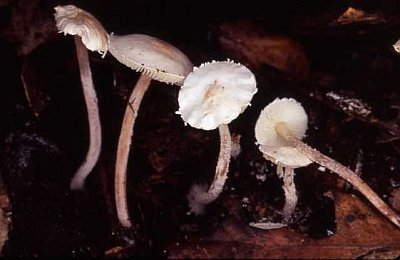
The bearded dapperling, Cystolepiota seminuda (Lasch) Bon.
Classification
Kingdom Fungi
Phylum Basidiomycota
Class Basidiomycetes
Order Agaricales
Family Agaricaceae
Genus Cystolepiota
Synonyms
Agaricus seminudus Lasch
Linnaea 3: 157 (1828)
Cystoderma seminudum (Lasch) Singer
(1945)
Cystolepiota seminuda var. sororia (Huijsman) Gminder
Die Grosspilze Baden-Württembergs,
4. Ständerpilze: Blätterpilze II (Stuttgart): 443 (2003)
Cystolepiota sistrata sensu auct. mult.
Cystolepiota sororia (Huijsman) Singer
Beih. Sydowia 7: 67 (1973)
Lepiota seminuda (Lasch) Gillet
Führ. Pilzk. (Zwickau): 136 (1871)
Lepiota seminuda f. minima J.E. Lange
Fl. Agaric. Danic. 1: 36 (1935)
Lepiota sistrata sensu auct. mult.
fide Checklist of Basidiomycota of Great Britain and Ireland (2005)
Lepiota sistrata f. minima (J.E. Lange) Babos
Annls hist.-nat. Mus. natn. hung. 50: 91 (1958)
Lepiota sororia Huijsman
Persoonia 1(3): 326 (1960)
Common names
Bearded dapperling
Lilliputian lepiota (Arora, 1990)
Bedla polonahá (Czech)
Blegpudret parasolhat (Danish)
Kleine poederparasol (Dutch)
Lepiote demi-nue (French)
Weisser Mehlschirmling (German)
Rosa melparasollsopp (Norwegian)
Czubniczka łysawa (Polish)
Blek puderskivling (Swedish)
My name is Austin Collins.
I've dedicated my life to Mushrooms.
I believe Mushrooms are the best kept secret when it comes to health and well being.
For that reason, I would like to share a company with you that in my opinion makes the best mushroom products on the market.
The company is called Noomadic Herbals, my favorite supplement they make is called "Mushroom Total".
I take their products every day and they have helped me think better and have more energy. Give them a try.
-Austin
Description
Cap: 3-20 mm diameter, hemispherical or conical when young, with inflexed margin and with veil remnants attached, expanding to plano-convex with or without low umbo; overall white surface color with white to cream to yellowish tinge at center; young specimens have a floccose to verrucose covering, later granulose to pruinose or even glabrous when very old or after heavy rain.
Gills: rather crowded, free or nearly free, ventricose to subventricose, 2-3 mm wide, white, yellowish-creamy, or with pale yellow tinge, with even to finely floccose, concolorous stem.
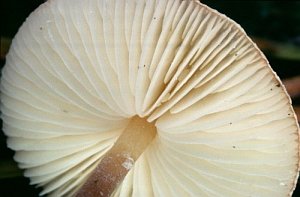
Stem: 15-50 x 1-3 mm, cylindrical, hollow, cream to pale lemon-yellow, with age and when touched in lower half and especially at base purplish or vinaceous pink, very rarely not discoloring at all, with tiny soft hairs at apex (pubescent), when young whitish pruinose, becoming glabrous with age; context thin, concolorous with surface.
Odor: not distinct to fruity/mushroomy.
Taste: indistinct.
Spore print: white.
Spores: 3.5-5.0 x 2.0-3.0 µm, ellipsoid to cylindrical, smooth, thin-walled, pale brown in Melzer’s reagent.
Edibility: unknown; too small to be of culinary value.
Habitat: solitary or gregarious on humus-rich soils in deciduous and coniferous woods. Aug-Oct.
Description adapted and modified from Bas et al., 1988, p. 158.
Medicinal properties
Antitumor effects
Polysaccharides extracted from the mycelial culture of C. seminuda and administered intraperitoneally (dosage 300 mg/kg) into white mice inhibited the growth of Sarcoma 180 and Ehrlich solid cancers by 70% and 60%, respectively (Ohtsuka et al., 1973).
References
Arora D. 1990.
Mushrooms Demystified (2nd ed.).
Berkelely: Ten speed press, 1020 pp.
Bas C, Kuyper TW, Noordeloos ME, Vellinga EC (eds). 1988.
Flora Agaricina Neerlandica. Critical monographs on families of agarics and boleti occurring in the Netherlands. Vol. 1. A. General part – B. Special part: Entolomataceae.
Balkema: Rotterdam-Brookfield, 182 pp.
Ohtsuka S, Ueno S, Yoshikumi C, Hirose F, Ohmura Y, Wada T, Fujii T, Takahashi E.
Polysaccharides having an anticarcinogenic effect and a method of producing them from species of Basidiomycetes.
UK Patent 1331513, 26 September 1973.
Vellinga EC.
Notes on Cystolepiota seminuda.
Persoonia. 1987 13(Part 3):321-5.