
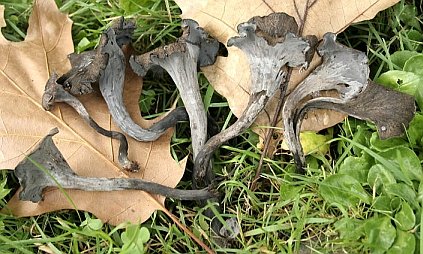
The black trumpet, Craterellus cornucopiodes (L.) Pers.
Classification
Kingdom Fungi
Phylum Basidiomycota
Class Basidiomycetes
Order Cantharellales
Family Cantharellaceae
Genus Craterellus
Synonyms
Cantharellus cornucopioides (L.) Fr.
Craterellus ochrosporus Burt
Merulius cornucopioides (L.) With.
Merulius cornucopioides (L.) Pers.
Merulius purpureus With.
Pezicula cornucopioides (L.) Paulet
Peziza cornucopioides L.
Pleurotus cornucopioides (Pers.) Gillet
Sterbeeckia cornucopioides (L.) Dumort.
Common names
Black trumpet
Black chanterelle
Horn of plenty
Trumpet of the dead
Description
Fruiting body: cap 3-8 cm diameter; trumpet or funnel-shaped with a folded margin which when fully grown is usually wavy or lobe-like; its inner part is at first dark brown; later very dark grey, even black; scaly; on the outside usually grayish-brown; at first smooth, later wrinkled. Outside completely covered with hymenium, so a mature fungus is white and covered with bloom. The stem body is 50-120 mm long, hollow, narrowing towards the base; at the top gradually merging into the cap.
Flesh: very easily broken, slightly leathery, at first grayish-black, later deep black. Black color and brittle when dry.
Taste: mild, smells pleasant.
Spore print: white.
Spores: 12-15 x 7-8.5 µm; ovoid or elliptical; colorless.
Habitat: found in deciduous woods, in clusters. August to November.
Distribution: North, Central, and South America, Europe, Asia, and Japan (Pilz, 2002, p.12)
Compositional analysis
A compositional analysis of several mushroom species, including C. cornucopioides, revealed that this species has 6.3 g/kg phosphorus, 37.1 g/kg potassium, and 0.24 g/kg calcium (all values expressed as dry weight). Additionally, this species was, by comparison, low in protein content, containing 28.3% dry weight (Vetter, 1993).
Medicinal properties
Antimutagenicity
Ethanolic extracts of the black trumpet inhibited the mutagenic effects of aflatoxin B1, benzo[a]pyrene, the acridine half mustard ICR-191 and 2-nitrofluorene in the Ames test for mutagenesis. Using the same test, the extracts had no inhibitory effects on 4-nitroquinoline-N-oxide, methyl methanesulfonate or N-methyl-N’-nitro-N-nitrosoguanidine (Gruter et al., 1990).
My name is Austin Collins.
I've dedicated my life to Mushrooms.
I believe Mushrooms are the best kept secret when it comes to health and well being.
For that reason, I would like to share a company with you that in my opinion makes the best mushroom products on the market.
The company is called Noomadic Herbals, my favorite supplement they make is called "Mushroom Total".
I take their products every day and they have helped me think better and have more energy. Give them a try.
-Austin
Links
References
Gruter A, Friederich U, Wurgler FE.
Antimutagenic effects of mushrooms.
Mutat Res. 1990 231(2):243-9.
Magnus V, Lacan G, Aplin RT, Thaller V.
Glycerol tridehydrocrepenynate from the basidiomycete Craterellus cornucopioides.
Phytochem. 1989 28(11):3047-50.
Magnus V, Lacan G, Iskric S, Lewer P, Aplin RT, Thaller V.
Conversion of indole-3-ethanol to fatty acid esters in Craterellus cornucopioides.
Phytochem. 1989 28(11):2949-54.
Ohtsuka S, Ueno S, Yoshikumi C, Hirose F, Ohmura Y, Wada T, Fujii T, Takahashi E.
Polysaccharides having an anticarcinogenic effect and a method of producing them from species of Basidiomycetes.
UK Patent 1331513, 26 September 1973.
Pilz D, Norvell L, Danell E, Molina R. (2002).
Ecology and management of commercially harvested chanterelle mushrooms.
United States Department of Agriculture. 90 pp.
PDF
Vetter J.
[Chemical composition of eight edible mushrooms].
Z Lebensm Unters Forsch. 1993 196:224-7. German.