
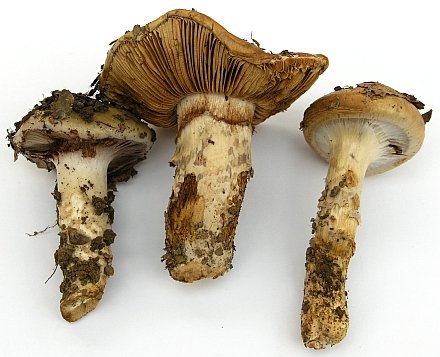
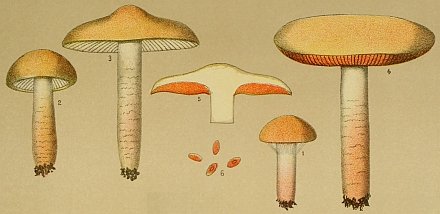
The belted slimy cort, Cortinarius collinitus (Pers.) Fr., member of a species complex. These specimens are from the Los Trancos Preserve, Palo Alto, California, USA.
Classification
Kingdom Fungi
Phylum Basidiomycota
Class Basidiomycetes
Order Agaricales
Family Cortinariaceae
Genus Cortinarius
Synonyms
Agaricus collinitus Pers.
Cortinarius cylindripes Kauffman (Bendiksen et al., 1992)
Cortinarius muscigenus Peck
Ann. Rep. N.Y. state Mus. 41: 71 (1888)
Common name
Belted slimy cort
Smeared cort
Pavučinec plavooranžový (Czech)
Spættet Slørhat (Danish)
Kangaslimaseitikki (Finnish)
Cortinaire collinéen/lubrifié (French)
Blaustieliger Schleimfuss (German)
Pavalku tīmeklene (Latvian)
Violettfotad slemspindling (Swedish)
Description
Cap: 2-10 cm diameter, intially campanulate, later convex then expanded with a low broad umbo, yellow-brown to golden or dark rust, often darker at centre, surface glutinous drying shiny, margin incurved at first, sometimes slightly grooved; margin often slightly paler than rest of cap.
Gills: adnate to adnexed, rather broad, bluish- or greyish-white (clay) when young, later rusty-brown.
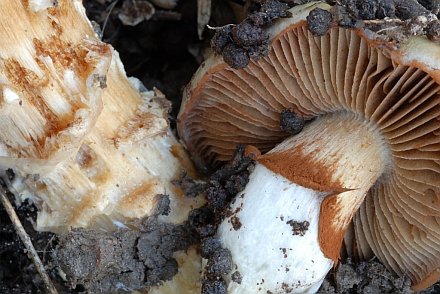
A close-up of the gills and stem, powdered with brown spores.
Stem: 5-12 cm long x 0.5-2 cm thick, cylindrical, solid, apex white to bluish, color usually paler then the cap; often covered in bluish bands of veil remains; viscid or glutinous when moist, when the gluten dries it cracks transversely, giving a scaly appearance; flesh whitish to yellowish, sometimes with blue tinges in stem apex.
Spore print: rusty-brown.
Spores: ellipsoid, rough, 10-15 x 6-8.5 µm.
Habitat: found on ground, solitary, scattered or gregarious in coniferous or mixed woods; late summer.
Taste and odor: not distinguishable.
Edibility: unknown; avoid eating as the Cortinarius genera is difficult to accurately identify and many species have toxins.
Description adapted from Arora (1986), p. 431.
Medicinal properties
Antitumor effects
Polysaccharides extracted from the mycelial culture of C. cortinarius and administered intraperitoneally into white mice at a dosage of 300 mg/kg inhibited the growth of Sarcoma 180 and Ehrlich solid cancers by 80% and 90%, respectively (Ohtsuka et al., 1973).
My name is Austin Collins.
I've dedicated my life to Mushrooms.
I believe Mushrooms are the best kept secret when it comes to health and well being.
For that reason, I would like to share a company with you that in my opinion makes the best mushroom products on the market.
The company is called Noomadic Herbals, my favorite supplement they make is called "Mushroom Total".
I take their products every day and they have helped me think better and have more energy. Give them a try.
-Austin
Links
- Mushroom Observer and BioPix have more photos
- C. collinitus is mentioned in this US patent on dietary supplements to improve immune function, treat malignancies and virus infection
References
Ammirti JF, Ovrebo CL.
Type studies of some Cortinarius and Tricholoma species described by Charles Horton Peck.
Mycotaxon. 1979 8(2):353-71.
Arora, D. (1986).
Mushrooms demystified.
Berkeley: Ten speed press. 959 pp.
Bendiksen E, Bendiksen K, Brandrud TE.
What is Cortinarius cylindripes Kauffman?
Persoonia. 1992 14(4):583-5.
Kuhner R.
Descriptive notes on the agarics of France. I. Cortinarius.
[Notes descriptives sur les agarics de France I. Cortinarius]
Bull Mensuel Soc Linn Lyon. 1959 28(4/5):121-7 and 131-141.
Ohtsuka S, Ueno S, Yoshikumi C, Hirose F, Ohmura Y, Wada T, Fujii T, Takahashi E.
Polysaccharides having an anticarcinogenic effect and a method of producing them from species of Basidiomycetes.
UK Patent 1331513, 26 September 1973.