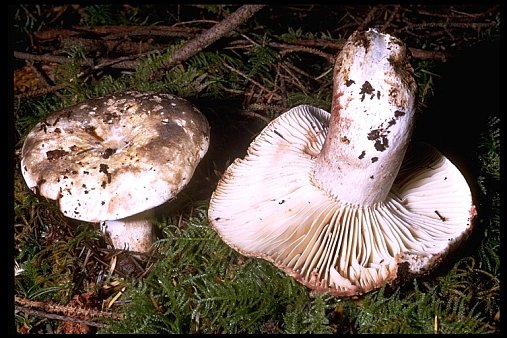
The blackening brittlegill, Russula nigricans (Bull.) Fr.
Synonyms
Agaricus elephantinus Sowerby
Coloured Figures of English Fungi …: tab. 28 (1788)
Agaricus nigrescens Lasch
Linnaea 4: 521 (1829)
Agaricus nigricans Bull.
Omphalia adusta ß elephantinus (Bolton) Gray
Nat. Arr. Brit. Pl. (London) 1: 614 (1821)
Russula elephantina (Bolton) Fr.
Epicr. syst. mycol. (Upsaliae): 350 (1838)
Common name
Blackening brittlegill
Dickblättriger Schwarztäubling (German)
Russule noircissante (French)
Description
Cap: 7.5-15 cm broad, firm, at first convex and umbilicate, becoming expanded and infundibuloform, whitish, becoming smoky umber to blackish, glabrous, slightly viscid when moist, margin incurved at first, not striate.
Flesh: firm, whitish, changing to reddish and then black when wounded, mild to slowly acrid.
Gills: adnexed, rounded or narrowed behind, subdistant to distant, broad, alternating long and short, whitish, changing to reddish when black when bruised.
Stem: 2-6.5 cm long, 1-2.5 cm thick, stout, equal, glabrous, whitish at first, becoming smoky brown with age, changing to reddish when black when bruised, solid.
Spores: white, subglobose 7-9 x 6-8 µm, ornamented with a network of fine lines joining low warts.
Habitat: gregarious or solitary on the ground or frondose woods, from July to September.
My name is Austin Collins.
I've dedicated my life to Mushrooms.
I believe Mushrooms are the best kept secret when it comes to health and well being.
For that reason, I would like to share a company with you that in my opinion makes the best mushroom products on the market.
The company is called Noomadic Herbals, my favorite supplement they make is called "Mushroom Total".
I take their products every day and they have helped me think better and have more energy. Give them a try.
-Austin
Bioactive compounds
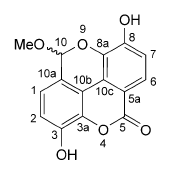
Nigricanin (shown below), the first ellagic acid related derivative from higher fungi, was isolated from the fruiting bodies (Tan et al., 2004). Ellagic acid is a polyphenol antioxidant found in various fruits and nuts, and is known to have both antioxidant and antitumor properties. It is possible that the antitumor activity attributed to R. nigricans may be due to nigricanin.
Medicinal properties
Antitumor activity
Polysaccharides extracted from the mycelial culture of R. nigricans and administered intraperitoneally into white mice at a dosage of 300 mg/kg inhibited the growth of Sarcoma 180 and Ehrlich solid cancers by 60% (Ohtsuka et al., 1973).
Molluscicidal activity
A dichloromethane extract of Russula nigricans was shown to be molluscicidal towards Biomphalaria glabrata (Keller et al., 2002).
Keller C, Maillard M, Keller J, Hostettmann K.
Screening of European fungi for antibacterial, antifungal, larvicidal, molluscicidal, antioxidant and free-radical scavenging activities and subsequent isolation of bioactive compounds.
Pharmaceutical Biology. 2002 40(7):518-25.
Ohtsuka S, Ueno S, Yoshikumi C, Hirose F, Ohmura Y, Wada T, Fujii T, Takahashi E.
Polysaccharides having an anticarcinogenic effect and a method of producing them from species of Basidiomycetes.
UK Patent 1331513, 26 September 1973.
Tan BW, Xu JB, Dong ZJ, Luo DQ, Liu JK
Nigricanin, the first ellagic acid derived metabolite from the Basidiomycete Russula nigricans.
Helv Chim Acta. 2004 87(4):1025-8.