
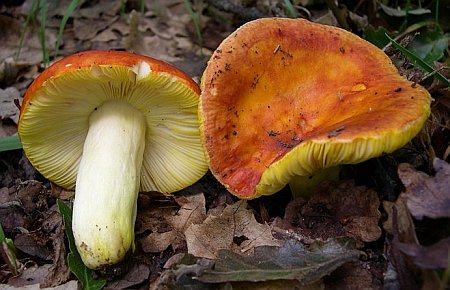
The gilded brittlegill, Russula aurea Pers.
Classification
Kingdom Fungi
Phylum Basidiomycota
Class Basidiomycetes
Order Russulales
Family Russulaceae
Genus Russula
Synonyms
Agaricus auratus With.
Bot. Arr. Brit. Pl., Edn 2 4: 184 (1801)
Russula aurata (With.) Fr.
Epicr. syst. mycol. (Upsaliae): 360 (1838)
Common name
Gilded brittlegill
Golden russula
Gylden skørhat (Danish)
Russule dorée (French)
Gold-Täubling (German)
Aranyos galambgomba (Hungarian)
Gullkremle (Norwegian)
Description
Cap: 4-9 cm diameter, red, blood-red, or reddish orange, often with yellow tinge around the margin; initially convex, later flattened and slightly depressed, smooth, margin grooved (sulcate) when mature, cuticle peeling halfway to center; flesh whitish, thick, granular and brittle.
Gills: pallid ochraceous, adnexed or free, broad, fairly distant.
Stem: 4-8 cm tall x 1-2.5 cm thick, white, equal, smooth
Spores: ellipsoid, hyaline, with conical warts (up to 1.5 µm), 7-10 x 6-8 µm.
Spore print: ochraceous.
Odor: not distinctive.
Taste: mild.
Edibility: edible.
Habitat: solitary or in scattered groups on the ground; summer to autumn.
My name is Austin Collins.
I've dedicated my life to Mushrooms.
I believe Mushrooms are the best kept secret when it comes to health and well being.
For that reason, I would like to share a company with you that in my opinion makes the best mushroom products on the market.
The company is called Noomadic Herbals, my favorite supplement they make is called "Mushroom Total".
I take their products every day and they have helped me think better and have more energy. Give them a try.
-Austin
Medicinal properties
Antitumor effects
Polysaccharides extracted from the mycelial culture of R. aurea and administered intraperitoneally into white mice at a dosage of 300 mg/kg inhibited the growth of Sarcoma 180 and Ehrlich solid cancers by 70% and 60%, respectively (Ohtsuka et al., 1973).
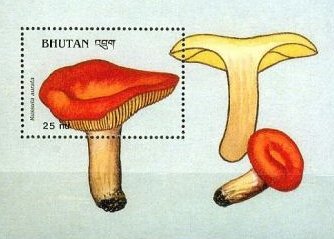
Links
- Fungi of Poland
- Errotari (Spanish language)
References
Ohtsuka S, Ueno S, Yoshikumi C, Hirose F, Ohmura Y, Wada T, Fujii T, Takahashi E.
Polysaccharides having an anticarcinogenic effect and a method of producing them from species of Basidiomycetes.
UK Patent 1331513, 26 September 1973.