Synonyms
Agaricus atricapillus Batsch
Agaricus cervinus Schaeff.
Agaricus curtisii Berk. & Broome
Agaricus pluteus Batsch
Agaricus pluteus ß rigens Pers.
Hyporrhodius cervinus (Schaeff.) Henn.
Pluteus atricapillus (Batsch) Fayod
Pluteus cervinus P. Kumm.
Pluteus curtisii Berk.
Rhodosporus cervinus (Schaeff.) J. Schröt.
Common name
Deer mushroom
Fawn mushroom
Rehbrauner Dachpilz (German)
Description
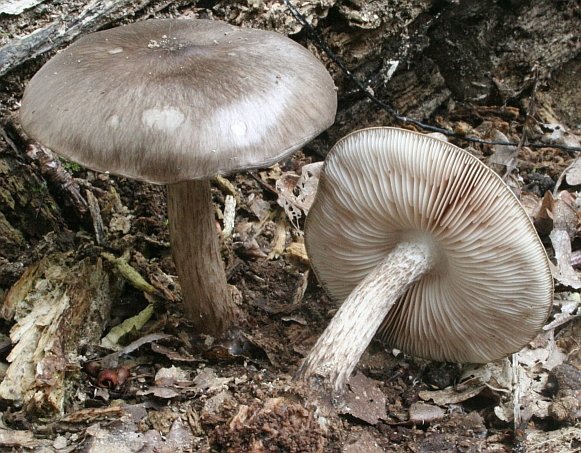
Cap: 5-12 cm broad, convex, nearly plane in age, umbonate; dark brown to grey-brown, lighter in age; smooth, sometimes streaked with radially oriented fibers, moist; flesh soft, white; odor of radish.
Gills: free, close, white, becoming pinkish to flesh-colored at maturity.
Stem: 5-10 cm tall, 0.5-1.5 cm thick, equal to enlarged at base; white to greyish-brown, sometimes with dark fibrils; veil absent.
Spores: 5.0-7.5 x 4-6 µm, smooth, elliptical.
Spore print: salmon-pink.
Habitat: Solitary to scattered on hardwood and conifer logs, occasionally from buried wood, in sawdust piles or wood chips; fruiting from after the first fall rains through mid-winter.
Edibility: Edible, but taste and texture are mediocre.
Medicinal properties
Anti-tumor effects
Polysaccharides extracted from the mycelial culture of P. cervinus and administered intraperitoneally into white mice at a dosage of 300 mg/kg inhibited the growth of Sarcoma 180 and Ehrlich solid cancers by 100% (Ohtsuka et al., 1973).
My name is Austin Collins.
I've dedicated my life to Mushrooms.
I believe Mushrooms are the best kept secret when it comes to health and well being.
For that reason, I would like to share a company with you that in my opinion makes the best mushroom products on the market.
The company is called Noomadic Herbals, my favorite supplement they make is called "Mushroom Total".
I take their products every day and they have helped me think better and have more energy. Give them a try.
-Austin
Links
Once featured in Tom Volk’s Fungus of the Month
Reference
Ohtsuka S, Ueno S, Yoshikumi C, Hirose F, Ohmura Y, Wada T, Fujii T, Takahashi E.
Polysaccharides having an anticarcinogenic effect and a method of producing them from species of Basidiomycetes.
UK Patent 1331513, 26 September 1973.