

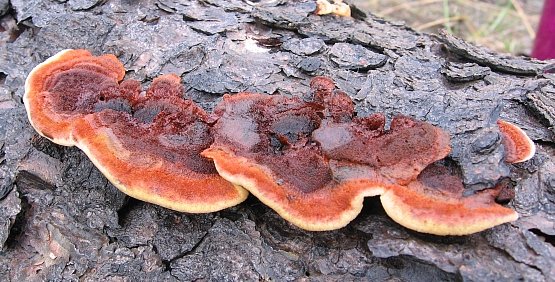
No, it’s not a piece of bacon… it’s Gloeophyllum sepiarium, found on a rotting log in the Northwest Territories (Canada).
Classification
Kingdom Fungi
Phylum Basidiomycota
Class Basidiomycetes
Order Polyporales
Family Gloeophyllaceae
Genus Gloeophyllum
Synonyms
Agaricus asserculorum Batsch
Agaricus boletiformis Sowerby
Agaricus sepiarius Wulfen
Agaricus undulatus Hoffm.
Daedalea confragosa var. tricolor (Fr.) Domański
(Aphyllophorales), Skórnikowate (Stereaceae)
Daedalea sepiaria (Wulfen) Fr.
Daedalea ungulata Lloyd
Gloeophyllum ungulatum (Lloyd) Imazeki
Lenzites argentina Speg.
Lenzites sepiaria (Wulfen) Fr.
Merulius sepiarius (Wulfen) Schrank
Common name
Rusty gilled polypore
Yellow-red gill polypore
Conifer mazegill
Zaunblattling (German)
Description
Fruiting body: up to 7 cm wide and 12 cm long; 0.5-1 cm thick; dark brown, margin orange to yellow or white when growing; fan-shaped; shelf-like; surface smooth to hairy.
Gills: densely and radially arranged, often fused together irregularly to give a maze-like appearance; ochre to brown; 1.5-2 per mm.
Spores: cylindric, 9–12.5 x 3–4.5 µm (a couple of photos of spores are available for viewing at Bioimages)
Spore print: white.
Habit and habitat: solitary or grouped on woods of conifers and hardwoods, causes brown rot. Jun-Nov. Found throughout North America and Europe.
Inedible.
Medicinal properties
Anti-tumor effects
The culture mycelia and fruit bodies of G. sepiarium showed 80% and 60% inhibition against Sarcoma 180 cancer, respectively, while the fruit bodies showed 60% inhibition against Ehrlich solid cancer (Ohtsuka et al., 1973).
My name is Austin Collins.
I've dedicated my life to Mushrooms.
I believe Mushrooms are the best kept secret when it comes to health and well being.
For that reason, I would like to share a company with you that in my opinion makes the best mushroom products on the market.
The company is called Noomadic Herbals, my favorite supplement they make is called "Mushroom Total".
I take their products every day and they have helped me think better and have more energy. Give them a try.
-Austin
Links
References
Ohtsuka S, Ueno S, Yoshikumi C, Hirose F, Ohmura Y, Wada T, Fujii T, Takahashi E.
Polysaccharides having an anticarcinogenic effect and a method of producing them from species of Basidiomycetes.
UK Patent 1331513, 26 September 1973.

How do you prepare this mushroom for use medicinally? Thank you.
Paige
As no one has yet left a reply, I thought I could. Although I am not familiar with this particular mushroom, as it is not common where I live, I am familiar with medicinal use of polypores. Many of them have water soluble components and other components that need alcohol to dissolve them. If you have a really good blender, you can dry and powder them, which might be easier to do by tearing them up and blending them partially before drying, then blending into a fine powder after drying. (The average blender won’t do it. You could burn out the motor.) The powder can be put in capsules, or added to soups or stews. Cooking mushrooms help with assimilation. With the powder, you are consuming the whole mushroom, and will get the most benefit.
The other option is to make tea and/or tincture. For either, cutting, tearing, or blending or food processing the mushroom into smaller pieces will help to get more out of it. If you are not making the tea or tincture immediately, the mushroom can be dried for storage. It will harden with drying, so break it up first.
For tincture, put the mushroom in a bottle and add alcohol. Fill the bottle about 1/3 full of mushroom. Use a high-proof alcohol. Some people use everclear; I find it too strong to be pleasant to use. I use vodka. Some people use brandy. Let steep in the alcohol for a few months. Use by the dropperful to teaspoonful. I sometimes add a sprig of thyme, oregano or rosemary to add to the flavor.
For tea, you probably will want to dry the mushroom for storage, as the tea can only be kept about 5 days in the refrigerator. Use about a tablespoon of dried mushroom per quart of water. You can put in other herbs for flavor. Bring to a boil, turn down, and simmer, lidded, as long as you have patience for. You’re supposed to get the most beta-glucans out by boiling for at least 6 hours. You get good flavor and some medicinal properties by boiling for a half-hour. (Add water as it boils out, or if the flavor is too strong.) You can make this overnight in a crock pot, or if you heat with wood, on the wood stove.