
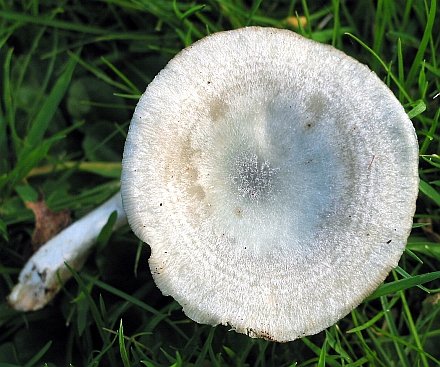
The aniseed funnelcap, Clitocybe odora (Bull.) P. Kumm.
Classification
Kingdom Fungi
Phylum Basidiomycota
Class Basidiomycetes
Order Agaricales
Family Tricholomataceae
Genus Clitocybe
Synonyms
Agaricus odorus Bull.
Herbier de la France 4: tab. 176 (1784) [1783-84]
Agaricus suaveolens sensu Fries (1821)
fide Checklist of Basidiomycota of Great Britain and Ireland (2005)
Agaricus trogii Fr.
Epicr. syst. mycol. (Upsaliae): 59 (1838)
Agaricus virens Scop., Fl. carniol.
Edn 2 (Wien) 2: 437 (1772)
Agaricus viridis Huds.
Flora angl.: 614 (1778)
Clitocybe odora var. alba J.E. Lange
Dansk bot. Ark. 6(no. 5): 45 (1930)
Clitocybe trogii (Fr.) Sacc.
Syll. fung. (Abellini) 5: 153 (1887)
Clitocybe virens (Scop.) Sacc.
Syll. fung. (Abellini) 5: 152 (1887)
Clitocybe viridis (With.) Gillet
Hyménomycètes (Alençon): 158 (1874)
Gymnopus odorus (Bull.) Gray
Nat. Arr. Brit. Pl. (London) 1: 606 (1821)
Lepista odora (Bull.) Harmaja
Karstenia 15: 15 (1976)
Rubeolarius odorus (Bull.) Raithelh.
Die Gattung Clitocybe (Stuttgart) 1: 17 (1981)
Common name
Aniseed funnel
Anise funnelcap
Anise-scented clitocybe
Description
Cap: 2-9 cm, convex at first, with incurved margin, later becoming flat or slightly depressed, applanate to subinfundibuloform, with subinvolute margin, not or only indistinctly hygrophanous, not translucently striate, white, radially streaked with hairs.
Gills: thin, crowded, segmentiform, up to 5 mm broad, broadly adnate to subdecurrent, white.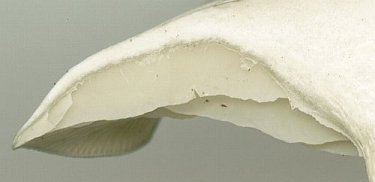
Stem: 2.5-6.5 x 0.6-1.2 cm, cylindrical, sometimes enlarged at base, stuffed, finally fistulose, concolorous with cap, fibrillose, at the base white-tomentose.
Smell: strong, like aniseed.
Taste: like the smell, mild.
Spore print: pale yellowish-pink to pinkish-cream.
Spores: 6.0-8.5 x 4.0-5.5 µm, smooth, nonamyloid, ellipsoid to ovoid.
Habitat: solitary or in groups on leaves or on ground, in coniferous and hardwood forests.
Edibility: although some guide books claim this mushroom to be edible, other advise against it as it contains small amounts of muscarine. In European countries it is often used as a flavoring agent.
In the odora variety, the cap has a bluish or greenish tinge, while in the fallax variety, the cap has a brown tinge.
(Description adapted from Bas et al., 1995, p. 43).
Odor analysis
Using GC-MS analysis, hydro-distillation and solvent extraction techniques, the anise fragrance of C. odora was determined to be due largely to the aroma compound p-anisaldehyde (Rapior et al., 2002).
Medicinal properties
Anti-tumor effects
Polysaccharides extracted from the mycelial culture of C. odora and administered intraperitoneally into white mice at a dosage of 300 mg/kg inhibited the growth of Sarcoma 180 and Ehrlich solid cancers by 70% and 60%, respectively (Ohtsuka et al., 1973).

My name is Austin Collins.
I've dedicated my life to Mushrooms.
I believe Mushrooms are the best kept secret when it comes to health and well being.
For that reason, I would like to share a company with you that in my opinion makes the best mushroom products on the market.
The company is called Noomadic Herbals, my favorite supplement they make is called "Mushroom Total".
I take their products every day and they have helped me think better and have more energy. Give them a try.
-Austin
References
Bas C, Kuyper TH, Noordeloos ME, Vellinga EC, Van Crevel R, Van Os J. (1995)
Flora Agaricina Neerlandica. Volume 3.
CRC Press. 200 pp.
Ohtsuka S, Ueno S, Yoshikumi C, Hirose F, Ohmura Y, Wada T, Fujii T, Takahashi E.
Polysaccharides having an anticarcinogenic effect and a method of producing them from species of Basidiomycetes.
UK Patent 1331513, 26 September 1973.
Rapior S, Breheret S, Talou T, Pelissier Y, Bessiere JM.
The anise-like odor of Clitocybe odora, Lentinellus cochleatus and Agaricus essettei.
Mycologia. 2002 94(3):373-6.
Hi. Today I gathered some clitocybe odora. I have never tried them before and am having difficulties finding ways to use them. They look and smell delicious! I read a suggestion to make them into a syrup, but cannot find a recipe. Then I saw they have a medicinal value. Can you give me some ideas or information please? I live in Oregon.
Thanks. Putt
The edibility of Clitocybe odora is iffy to say the least. Some mycologists claim it’s edible and some claim it’s not. I would be safe, not eat it and err on the side of caution.