
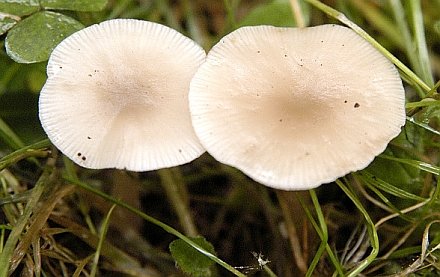
The hygrophanous, striate appearance of the fragrant funnel, Clitocybe fragrans (With.) P. Kumm.
Classification
Kingdom Fungi
Phylum Basidiomycota
Class Basidiomycetes
Order Agaricales
Family Tricholomataceae
Genus Clitocybe
Synonyms
Agaricus fragrans With.
Bot. Arr. Brit. Pl., Edn 2 3: 307 (1792)
Clitocybe deceptiva H.E. Bigelow
Beih. Nova Hedwigia 72: 108 (1982)
Clitocybe depauperata (J.E. Lange) P.D. Orton
Trans. Br. mycol. Soc. 43: 174 (1960)
Clitocybe fragrans var. depauperata J.E. Lange
Dansk bot. Ark. 6(no. 5): 56 (1930)
Clitocybe obsoleta sensu auct.; fide Checklist of Basidiomycota of Great Britain and Ireland (2005)
Lepista fragrans (With.) Harmaja
Karstenia 15: 14 (1976)
Omphalia fragrans (With.) Gray
Nat. Arr. Brit. Pl. (London) 1: 613 (1821)
Pseudolyophyllum fragrans (With.) Raithelh.
Metrodiana 7(P4): 73 (1979) [1978]
Common names
Fragrant funnel
Slim anise mushroom
Slanke anijstrechterzwam (Dutch)
Clitocybe parfumé (French)
Dufttrichterling (German)
Description
Cap: 1.5-4 cm diameter, when young flat (applanate), then shallowly infundibuloform, with margin involute when young, hygrophanous, translucently striate or not striate, sometimes with a dark brown to dark red-brown center, much paler in the outer part, other times with a less contrasting center (as depicted above), becoming pale on drying to almost whitish, but center remaining dark, or pale throughout, smooth and glabrous.
Gills: thin, crowded, up to 3 mm broad, adnate to decurrent, white.
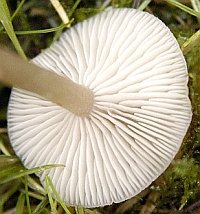
Stem: 3-6 x 0.2-0.5 cm, cylindrical, equal, stuffed, finally hollow, light brown, smooth, white-tomentose at base, sometimes curved at base. Context hygrophanous, concolorous with cap and stem.
Smell: strong, like aniseed or Melilot (sweet clover)
Taste: indistinct.
Spore print: very pale cream to orange cream.
Habitat: in groups, often growing amongst moss, under deciduous trees on nutrient-rich soil, sometimes under coniferous trees or in juniper scrub or in calcareous grassland; summer to autumn.
Edibility: edible, but their similarity to other poisonous mushrooms suggests that consumption be avoided.
Description adapted from Noordeloos et al., 1985, p. 59
Medicinal properties
Anti-tumor effects
Polysaccharides extracted from the mycelial culture of C. fragrans and administered intraperitoneally into white mice at a dosage of 300 mg/kg inhibited the growth of Sarcoma 180 and Ehrlich solid cancers by 80% (Ohtsuka et al., 1973).
My name is Austin Collins.
I've dedicated my life to Mushrooms.
I believe Mushrooms are the best kept secret when it comes to health and well being.
For that reason, I would like to share a company with you that in my opinion makes the best mushroom products on the market.
The company is called Noomadic Herbals, my favorite supplement they make is called "Mushroom Total".
I take their products every day and they have helped me think better and have more energy. Give them a try.
-Austin
Links
There’s a number of pictures at Mushroom Observer
References
Noordeloos ME, Boekhout T, Vellinga EC, Arnolds EJM. (1988).
Flora Agaricina Neerlandica: critical monographs on families of agarics and boleti occurring in the Netherlands, v. 3.
CRC Press.
Ohtsuka S, Ueno S, Yoshikumi C, Hirose F, Ohmura Y, Wada T, Fujii T, Takahashi E.
Polysaccharides having an anticarcinogenic effect and a method of producing them from species of Basidiomycetes.
UK Patent 1331513, 26 September 1973.