
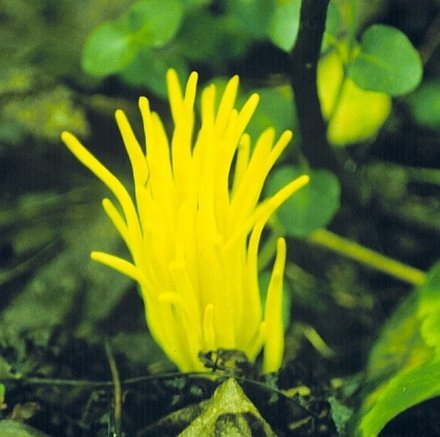
The yellow spindle coral, Clavulinopsis fusiformis (Sowerby) Corner.
Classification
Kingdom Fungi
Phylum Basidiomycota
Class Basidiomycetes
Order Agaricales
Family Clavariaceae
Genus Clavulinopsis
Synonyms
Clavaria ceranoides Pers.
Syn. meth. fung. (Göttingen) 2: 594 (1801)
Clavaria compressa Schwein.
Trans. Am. phil. Soc., New Series 4(2): 182 (1832)
Clavaria fusiformis Sowerby
Coloured Figures of English Fungi 2: 98 (1799) [1798-99]
Clavaria fusiformis var. ceranoides W.G. Sm.
Brit. Basid.: 434 (1908)
Clavaria inaequalis var. fusiformis (Sowerby) Fr.
Elench. fung. (Greifswald) 1: 231 (1828)
Clavaria platyclada Peck
Bull. Torrey bot. Club 23: 419 (1896)
Ramaria ceranoides (Pers.) Gray
Nat. Arr. Brit. Pl. (London) 1: 655 (1821)
Ramariopsis fusiformis (Sowerby) R.H. Petersen
Mycologia 70(3): 668 (1978)
Common names
Yellow spindle coral
Golden fairy spindle
Tongues of flame
Slender golden fingers
Description
Fruiting body: 2-8 cm high, 0.2-0.6 cm diameter, bright yellow, cylindrical, unbranched, often laterally compressed and grooved, tips blunt or pointed, becoming reddish to brown in age; no obvious distinction between fruiting body and stem.
Flesh: solid in younger specimens, hollow in age.
Spores: smooth, thin-walled, hyaline, globose to sub-globose with distinct apiculus, entire, non-amyloid, with droplets, 5-6.5 x 4.5-6 µm.
Spore print: buff.
Odor: not distinctive.
Taste: slightly bitter.
Edibility: edible or inedible, depending on the guidebook you use; not poisonous.
Habitat: typically in clusters on soil in grasslands, humus, in light forests under conifers, or in fields; late summer to autumn.
Chemical tests: flesh turns green in ferric sulphate.
Biochemistry
The extract of Clavulinopsis fusiformis was shown to contain lectins with an anti-B agglutinin specificity (Furukawa et al., 1995).
Medicinal properties
Antitumor effects
Polysaccharides extracted from the mycelial culture of C. fusiformus and administered intraperitoneally into white mice at a dosage of 300 mg/kg inhibited the growth of Sarcoma 180 and Ehrlich solid cancers by 80% (Ohtsuka et al., 1973).
My name is Austin Collins.
I've dedicated my life to Mushrooms.
I believe Mushrooms are the best kept secret when it comes to health and well being.
For that reason, I would like to share a company with you that in my opinion makes the best mushroom products on the market.
The company is called Noomadic Herbals, my favorite supplement they make is called "Mushroom Total".
I take their products every day and they have helped me think better and have more energy. Give them a try.
-Austin
Links
Mushroom Expert and California Fungi have additional descriptive information. American mushrooms has a number of additional photos.
References
Furukawa K, Ying R, Nakajima T, Matsuki T.
Hemagglutinins in fungus extracts and their blood group specificity.
Exp Clin Immun. 1995 12(4):223-31.
Ohtsuka S, Ueno S, Yoshikumi C, Hirose F, Ohmura Y, Wada T, Fujii T, Takahashi E.
Polysaccharides having an anticarcinogenic effect and a method of producing them from species of Basidiomycetes.
UK Patent 1331513, 26 September 1973.

Greetings. Hace you ever cone upon a medicinal extract of clavulinopsus fusiformis before?