Classification
Kindgom Fungi
Phylum Basidiomycota
Class Basidiomycetes
Order Dacrymycetales
Family Dacrymycetaceae
Genus Calocera
Synonyms
Calocera cavarae Bres. & Cavara
Calocera flammea Fr.
Calocera stricta Fr.
Calocera viscosa var. cavarae (Bres.) McNabb
Clavaria viscosa Pers.
Common names
Yellow staghorn fungus
Staghorn jelly fungus
Jelly antler fungus
Yellow antler fungus
Yellow tuning fork
Description
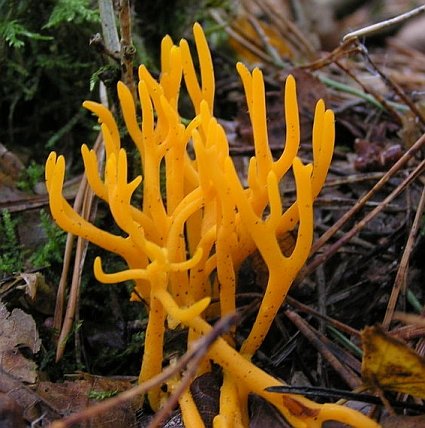
Fruiting body: 3-10 cm tall; yellow when moist, orange-yellow when dry; variable in shape – may be cupulate, spathulate, resupinate or coralloid; upper branches often forked; smooth.
Flesh: yellow, gelatinous, tough.
Spores: hyaline, smooth, allantoid or elongated, non-amyloid, 7-10 x 3-4.5 µm.
Habitat: saprobic; several to many on dead conifer logs and stumps; Aug – Nov.
The tough, gelatinous texture of Calocera viscosa helps to distinguish it from the more brittle coral fungi.
Bioactive compounds
The indole metabolite 5-hydroxytryptophan was found in Calocera viscosa mycelium grown in shake cultures (Kholmunzer et al., 2000).
Antitumor properties
Polysaccharides extracted from the mycelial culture of C. viscosa and administered intraperitoneally into white mice at a dosage of 300 mg/kg inhibited the growth of Sarcoma 180 and Ehrlich solid cancers by 90% (Ohtsuka et al., 1973).
My name is Austin Collins.
I've dedicated my life to Mushrooms.
I believe Mushrooms are the best kept secret when it comes to health and well being.
For that reason, I would like to share a company with you that in my opinion makes the best mushroom products on the market.
The company is called Noomadic Herbals, my favorite supplement they make is called "Mushroom Total".
I take their products every day and they have helped me think better and have more energy. Give them a try.
-Austin
References
Kohlmunzer S, Wegiel J, Muszynska B, Sulkowska-Ziaja K, Gouillot, J.
Indole metabolites in mycelial culture of higher fungi.
Herba Polonica 2000 46(2):98-104.
Ohtsuka S, Ueno S, Yoshikumi C, Hirose F, Ohmura Y, Wada T, Fujii T, Takahashi E.
Polysaccharides having an anticarcinogenic effect and a method of producing them from species of Basidiomycetes.
UK Patent 1331513, 26 September 1973.