Basionym
Clavaria purpurea (Fr.)
Syst. mycol. (Lundae) 1: 480 (1821)
Synonyms
Bul. Torrey Bot. Club 25:326 (1898)
Clavaria occidentalis Zeller
Mycologia 21:97 (1929)
Clavaria fumosoides Kauffman
Pap. Michigan Acad. 8:145 (1929)
Classification
Kingdom Fungi
Phylum Basidiomycota
Class Basidiomycetes
Order Agaricales
Family Clavariaceae
Genus Alloclavaria
Phylogenetic analysis of ribosomal DNA sequences from a variety of clavarioid fungi strongly suggest that this fungus be placed in its own separate genus, Alloclavaria (Dentinger and McLaughlin, 2006).
Common names
Purple coral
Purple fairy club
Purple spindles
Purple squid mushroom
Kyjanka purpurová (Czech)
Purpurgrå køllesvamp (Danish)
Purppuranuijakkaat Purppura (Finnish)
Clavaire pourprée (French)
Purpurfarbige (German)
Gråfiolett køllesopp (Norwegian)
Goździeniec purpurowy (Polish)
Клавария пурпурная (Russian)
Kyjačik purpurový (Slovak)
Luddfingersvamp (Swedish)
Description
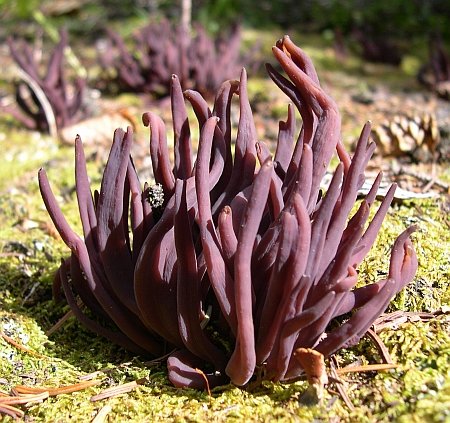
Fruiting body: variable in size – up to 15 cm tall x 2-8 mm thick, elongate-fusoid, unbranched, often flattened on one side or grooved, usually crooked and twisted; color various shades of purple, brown or smoky, color fading with age, paler or whitish towards base, sometimes with white mycelium; hymenial portion minutely pruinose; flesh white or purplish.
Stem: indistinct.
Spores: ellipsoid, fusoid to obovate, hyaline, smooth, thin-walled, 7-9.5 x 3.5-5.5 µm.
Odor and taste: mild.
Edibility: edible but insubstantial.
Habitat: single, caespitose or gregarious, found on ground in coniferous forests, often in moss and near spruce and fir; fruiting in spring to early fall.
Description adapted from Olexia, 1968 and Coker, 1974, p. 51.
Medicinal properties
Antitumor effects
Polysaccharides extracted from the mycelial culture of A. purpureaand administered intraperitoneally into white mice at a dosage of 300 mg/kg inhibited the growth of Sarcoma 180 and Ehrlich solid cancers by 80% and 70%, respectively (Ohtsuka et al., 1973).
My name is Austin Collins.
I've dedicated my life to Mushrooms.
I believe Mushrooms are the best kept secret when it comes to health and well being.
For that reason, I would like to share a company with you that in my opinion makes the best mushroom products on the market.
The company is called Noomadic Herbals, my favorite supplement they make is called "Mushroom Total".
I take their products every day and they have helped me think better and have more energy. Give them a try.
-Austin
Links
References
Coker WC. (1974).
The Club and Coral Mushrooms (Clavarias) of the United States and Canada.
Courier Dover Publications. 209 pp.
Google Book preview
Dentinger BTM, McLaughlin DJ.
Reconstructing the Clavariaceae using nuclear large subunit rDNA sequences and a new genus segregated from Clavaria.
Mycologia. 2006 98(5):746-62.
Ohtsuka S, Ueno S, Yoshikumi C, Hirose F, Ohmura Y, Wada T, Fujii T, Takahashi E.
Polysaccharides having an anticarcinogenic effect and a method of producing them from species of Basidiomycetes.
UK Patent 1331513, 26 September 1973.
Olexia PD. (1968).
The genus Clavaria sensu strictu in North America.
University of Tennessee PhD thesis. 94 pp.