
Synonyms
Agaricus foetens Pers., Observ. mycol. (Lipsiae) 1: 102 (1796)
Common name
Fetid russula
Description
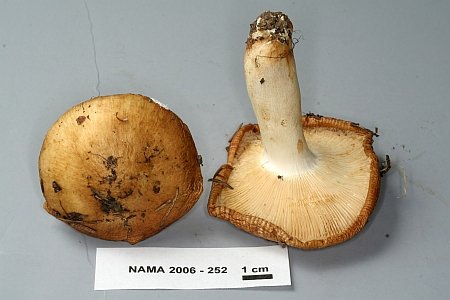
Cap: 5-10 cm diameter, at first firm, becoming fragile, at first nearly globose, expanding and becoming plane to slightly depressed, yellowish or dingy ochraceous, glabrous, viscid, pellicle separable part way to the disk, margin widely and coarsely tuberculate-striate.
Flesh: thin, rather fragile, dingy white, yellowish under the pellicle, taste acrid, odor strong, resembling bitter almonds, then fetid.
Gills: adnexed, rather close, broad, at first whitish, becoming yellowish with age and dingy when bruised, exuding drops of water when young, some forked.
Stem: 5-12 cm high, 1.5-4 cm thick, equal or slightly tapering downwards, veined, white or dingy brown in age or when bruised, stuffed, becoming hollow.
Spores: hyaline, globose to subglobose, 8-10 x 7-9 µm, ornamented with warts.
Spore print: pale yellow.
Habitat: gregarious on the ground in mixed woods, summer to autumn. Common.
Edibility: Inedible.
Chemical tests: flesh salmon-pink with FeSO4.
My name is Austin Collins.
I've dedicated my life to Mushrooms.
I believe Mushrooms are the best kept secret when it comes to health and well being.
For that reason, I would like to share a company with you that in my opinion makes the best mushroom products on the market.
The company is called Noomadic Herbals, my favorite supplement they make is called "Mushroom Total".
I take their products every day and they have helped me think better and have more energy. Give them a try.
-Austin
Bioactive compounds
A number of marasmane sesquiterpenes have been isolated from the fruiting bodies of Russula foetens:
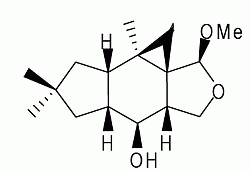
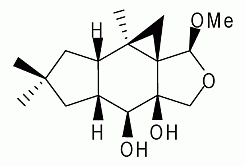
– 8α,13-dihydroxy-marasm-5-oic acid γ-lactone
– 13-hydroxy-marasm-7(8)-en-5-methoxy γ-acetal
– 7α, 8α, 13-trihydroxy-marasm-5-oic acid γ-lactone
The first two compounds were reported by Wang et al., 2005, the latter three in Wang et al., 2006.
Marasmane sesquiterpenoids have also been found in Lactarius piperatus.
Medicinal properties
Antitumor effects
Polysaccharides extracted from the mycelial culture of R. foetens and administered intraperitoneally into white mice at a dosage of 300 mg/kg inhibited the growth of Sarcoma 180 and Ehrlich solid cancers by 70% (Ohtsuka et al., 1973).
Links
See some more photos of the fetid russula at BioPix
References
Ohtsuka S, Ueno S, Yoshikumi C, Hirose F, Ohmura Y, Wada T, Fujii T, Takahashi E.
Polysaccharides having an anticarcinogenic effect and a method of producing them from species of Basidiomycetes.
UK Patent 1331513, 26 September 1973.
Saini SS, Atri NS.
Russula foetens (Pers) Fr. – a new record for India.
Curr Sci. 1981 (10):460-1.
Wang XN, Shen JH, Du JC, Liu JK.
Marasmane sesquiterpenes isolated from Russula foetens.
J Antibiot (Tokyo). 2006 59(10):669-72.
Wang XN, Wang F, Du JC, Ge HM, Tan RX, Liu JK.
A new marasmane sesquiterpene from the basidiomycete Russula foetens.
Zeitschrift Für Naturforschung Section B-A J Chemical Sciences 2005 60(10): 1065-7.