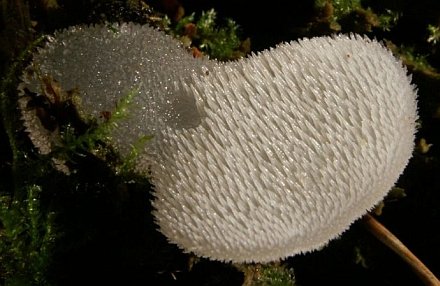
The toothed jelly fungus, Pseudohydnum gelatinosum (Scop.) P. Karst.
Synonyms
Hydnogloea gelatinosa (Scop.) Curr. ex Berk.
Grevillea 1(no. 7): 101 (1873)
Hydnum gelatinosum Scop., Fl. carniol.
Edn 2 (Wien) 2: 472 (1772)
Steccherinum gelatinosum (Scop.) Gray
Nat. Arr. Brit. Pl. (London) 1: 651 (1821)
Tremellodon gelatinosum (Scop.) Pers.
Hymenomyc. eur. (Upsaliae): 618 (1874)
Common names
Toothed jelly fungus
False hedgehog mushroom
White jelly mushroom
Jelly tongue
Jelly false tooth
Gallertiger Zitterzahn (German)
Eispilz (German)
Tremellodon gélatineux (French)
Tremelle gélatineuse (French)
Description
Fruiting body: 1-8 cm diameter, tongue- or spoon-shaped, flexible, rubbery, gelatinous; surface minutely roughened to almost smooth.
Teeth: pointed and conspicuous, transparent to white.
Stem: continuous with cap, up to 6 cm long, lateral; sometimes absent.
Spore print: white.
Spores: ovoid to subglobose, 5-7 x 5 µm.
Habitat: grows solitary, scattered or gregarious on rotting logs, twigs, and humus; saprobic; thrives in cool, wet weather (autumn).
Edibility: edible but bland.
Bioactive compounds
Medicinal properties
Antitumor activity
Polysaccharides extracted from the mycelial culture of P. gelatinosum and administered intraperitoneally into white mice at a dosage of 300 mg/kg inhibited the growth of Sarcoma 180 and Ehrlich solid cancers by 90% (Ohtsuka et al., 1973).

My name is Austin Collins.
I've dedicated my life to Mushrooms.
I believe Mushrooms are the best kept secret when it comes to health and well being.
For that reason, I would like to share a company with you that in my opinion makes the best mushroom products on the market.
The company is called Noomadic Herbals, my favorite supplement they make is called "Mushroom Total".
I take their products every day and they have helped me think better and have more energy. Give them a try.
-Austin
Links
Mushroom Expert
Mykoweb
CalPhotos
Austrialianfungi.blogspot
Fungi on wood
BioPix
References
Francis SM.
Jelly fungi.
Mycologist. 1992 6(2):78-79.
Ohtsuka S, Ueno S, Yoshikumi C, Hirose F, Ohmura Y, Wada T, Fujii T, Takahashi E.
Polysaccharides having an anticarcinogenic effect and a method of producing them from species of Basidiomycetes.
UK Patent 1331513, 26 September 1973.
Pemberton RT.
Agglutinins (lectins) from some British higher fungi.
Mycol Res. 1994 98:277-90 Part 3.

Found for 1st time on a foray last week, found a suggestion online on how to consume, candying with a flavour, so used my maple syrup and lemon juice boiled for maybe 1/2 hr on low, let sit for a day and with pleasure ate little by little for a few days. Sorry I did not pick much more as found! I feel from the flavourlessness and texture it is likely a good “spleen” tonic (per tcm).