
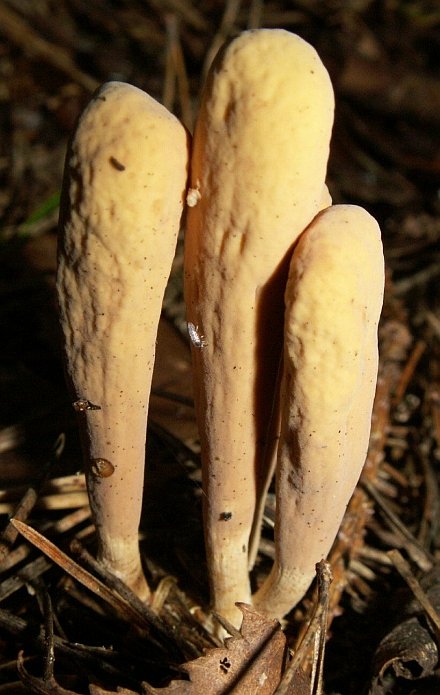
The strap coral mushroom, Clavariadelphus ligula (Schaeff.) Donk.
Classification
Kingdom Fungi
Phylum Basidiomycota
Class Basidiomycetes
Order Phallales
Family Gomphaceae
Genus Clavariadelphus
Synonym
Clavaria ligula Schaeff.
Fung. Bavar. Palat. 4: 116 (1774)
Common names
Strap coral mushroom
Tongue mushroom
Description
Fruiting body: 3-10 cm tall, 0.5-1.5 cm wide (at apex), cylindrical to narrowly clavate, the apex appearing slightly flattened or blunt; surface roughened, cream to orange-buff to yellowish-brown, fine white tomentose base.
Flesh: spongy, not brittle, white;green in ferric sulphate solution.
Odor: none.
Taste: slightly bitter.
Spores: 8-18 x 3-6 µm, nonamyloid, ellipsoid, smooth, entire.
Spore print: white.
Edibility: inedible.
Habitat: gregarious, clustered or caespitose, under many different conifers. Widely distributed; summer-fall.
Biochemistry
Medicinal properties
Antitumor effects
Polysaccharides extracted from the mycelial culture of C. ligula and administered intraperitoneally into white mice at a dosage of 300 mg/kg inhibited the growth of Sarcoma 180 and Ehrlich solid cancers by 60% (Ohtsuka et al., 1973).
My name is Austin Collins.
I've dedicated my life to Mushrooms.
I believe Mushrooms are the best kept secret when it comes to health and well being.
For that reason, I would like to share a company with you that in my opinion makes the best mushroom products on the market.
The company is called Noomadic Herbals, my favorite supplement they make is called "Mushroom Total".
I take their products every day and they have helped me think better and have more energy. Give them a try.
-Austin
References
Ohtsuka S, Ueno S, Yoshikumi C, Hirose F, Ohmura Y, Wada T, Fujii T, Takahashi E.
Polysaccharides having an anticarcinogenic effect and a method of producing them from species of Basidiomycetes.
UK Patent 1331513, 26 September 1973.