
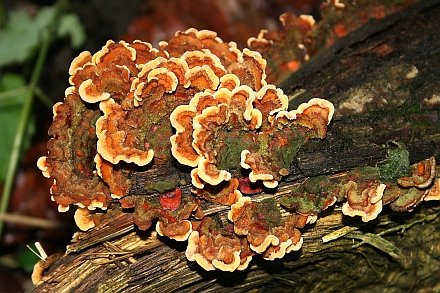
The bleeding oak crust mushroom, Stereum gausapatum (Fr.) Fr.
Synonyms
Cladoderris gausapata (Fr.) Fr.
Summa veg. Scand., Section Post. (Stockholm): 142 (1849)
Haematostereum gausapatum (Fr.) Pouzar
Česká Mykol. 13: 13 (1959)
Stereum cristulatum Quél.
Mém. Soc. Émul. Montbéliard, Sér. 2 5: 15 (1875)
Stereum quercinum Potter
Lich. Suec. exs.: 7 (1901)
Thelephora gausapata Fr.
Elench. fung. (Greifswald) 1: 171 (1828)
Common names
False turkey tail
Bleeding oak crust
Hirsutum Eikebloedzwam (Dutch)
Stérée du chêne (French)
Brauner Schichtpilz (German)
Description
Fruiting body: 1-4 cm diameter x 0.2-0.4 cm thick; upper surface ochraceous-brown to grey with more pallid margin, finely downy, concentrically zoned, wavy; lower hymenial surface (outer surface when resupinate) reddish brown, smooth; resupinate or reflexed.
Flesh: reddish ochre, thin; when damp elastic and tough, when dry hard and brittle; turning red where cut.
Spores: smooth, hyaline, weakly amyloid, 6.5-9 x 3-4 µm. According to Chamuris (1985), this species may be distinguished microscopically from Stereum hirsutum by the latter’s average pseudocystidial wall thickness > 1.5 µm (S. gausapatum is <1.5 µm).
Taste and odor: not distinctive.
Edibility: inedible.
Habitat: grows on hardwoods, especially oak (Quercus spp.), on logs, limbs and stumps, causing a heart rot; common.
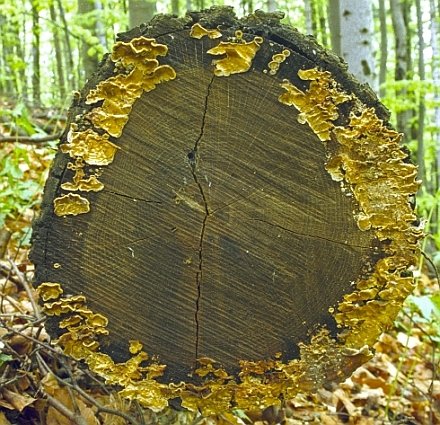
Other species of Stereum that bleed red include S. sanguinolentum and S. rugosum. The former grows only on decayed wood of conifers, while the latter grows on hardwoods. In general, S. gausapatum may be distinguished from S. rugosum by the much darker brown hymenium (usually being reddish brown with a paler zone around the margin), although the state of hydration affects the overall color of these specimens.
Medicinal properties
Antitumor effects
Polysaccharides extracted from the mycelial culture of S. gausapatum and administered intraperitoneally into white mice at a dosage of 300 mg/kg inhibited the growth of Sarcoma 180 and Ehrlich solid cancers by 90% and 100%, respectively (Ohtsuka et al., 1973).
My name is Austin Collins.
I've dedicated my life to Mushrooms.
I believe Mushrooms are the best kept secret when it comes to health and well being.
For that reason, I would like to share a company with you that in my opinion makes the best mushroom products on the market.
The company is called Noomadic Herbals, my favorite supplement they make is called "Mushroom Total".
I take their products every day and they have helped me think better and have more energy. Give them a try.
-Austin
References
Chamuris GP.
On distinguishing Stereum gausapatum from the Stereum hirsutum complex.
Mycotaxon. 1985 22(1):1-12.
Ohtsuka S, Ueno S, Yoshikumi C, Hirose F, Ohmura Y, Wada T, Fujii T, Takahashi E.
Polysaccharides having an anticarcinogenic effect and a method of producing them from species of Basidiomycetes.
UK Patent 1331513, 26 September 1973.