
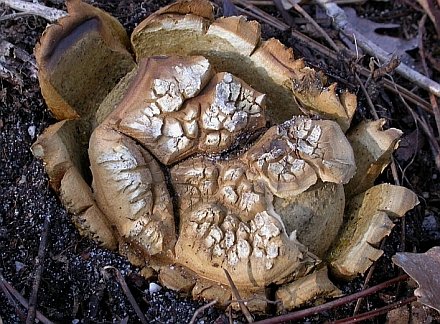
The irregularly stellate form of Scleroderma polyrhizum (J.F. Gmel.) Pers.
Synonyms
Lycoperdon polyrhizon J.F. Gmel.
Syst. Nat. 2: 1464 (1796)
Scleroderma geaster Fr.
Syst. mycol. (Lundae) 3(1): 46 (1829)
Scleroderma polyrhizon
Common names
Earthstar scleroderma
Dead man’s hand
Description
Fruiting body: subglobose to globose, sometimes flattened or irregular; sporocarp 4-13 cm diameter; color initially whitish, then yellowish or browish; base sessile with rhizoid mass; sometimes buried or partially buried (hypogeous) before maturity.
Exoperidium: coffee color, up to 5 mm thickness, smooth or squamulose, often splitting open irregularly to form recurved fins in a stellate manner.
Gleba: when young, purple and firm with oval locules separated by white membranes; in older specimens black-brown and powdery.
Odor: none
Spore mass: dark brown.
Spores: subreticulate, globose, thick-walled, 6-10 µm diameter with spines up to 0.8 µm long.
Habitat: solitary to gregarious, on hard clay or sandy soil under hardwoods, along roads, in gravel or other poor soils.
Edibility: consumption not advised; Miller and Miller (2006) warn of gastric disturbance and type 8 toxins.
This mushroom is on the red list of threatened fungi in Japan.
Use in traditional medicine
The fruitbodies of Scleroderma polyrhizum have been used in traditional Chinese medicine for the treatment of detumescence and hemostasis (Gong et al., 2005).
Bioactive compounds/Antitumor/Antiinflammatory
Three nitrogen compounds have been isolated and purified from the fruit bodies of S. polyrhizum, determined to be N,N-dimethylphenylalanine, 2-N,N,N-trimethyl-phenylalanine, 2-trimethyl-ammonio-3–(3-indolyl)propionate (Gong et al., 2005).
Fruit bodies have also been shown to contain the steroids ergosta-4,6,8(14),22-tetraen-3-one and ergosterol peroxide (5α,8α-epidoxyergosta-6,22-dien-3β-ol) as well as the fatty acids palmitate and oleate (Gonzalez et al., 1983). Ergosterol peroxide is a known major anti-cancer and antiinflammatory sterol produced by a variety of medicinal mushrooms (see for example Takei et al., 2005 or Kobori et al., 2007).
My name is Austin Collins.
I've dedicated my life to Mushrooms.
I believe Mushrooms are the best kept secret when it comes to health and well being.
For that reason, I would like to share a company with you that in my opinion makes the best mushroom products on the market.
The company is called Noomadic Herbals, my favorite supplement they make is called "Mushroom Total".
I take their products every day and they have helped me think better and have more energy. Give them a try.
-Austin
Links
Pictures of fruiting bodies and spores at Mushroomhobby
Mushroom Expert
Key to the Sclerodermataceae in the Pacific Northwest
References
Gong XL, Zeng RS, Luo SM.
Chemical constituents from the fruit bodies of Scleroderma polyrhizum.
Nat Prod Res Dev. 2005 17(4):431-3.
Gonzalez, AG, Barrera, JB, Marante, FJT.
The steroids and fatty-acids of the Basidiomycete Scleroderma polyrhizum.
Phytochem. 1983 22(4):1049-50.
Kobori M, Yoshida M, Ohnishi-Kameyama M, Shinmoto H.
Ergosterol peroxide from an edible mushroom suppresses inflammatory responses in RAW264.7 macrophages and growth of HT29 colon adenocarcinoma cells.
Br. J. Pharmacol. 2007. 150:209-19.
Abstract
Miller OK, Miller H. (2006).
North American Mushrooms: A Field Guide to Edible and Inedible Fungi.
Globe Pequot Press, 583 pp.
ISBN:0762731095
Takei T, Yoshida M, Ohnishi-Kameyama M, Kobori M.
Ergosterol peroxide, an apoptosis-inducing component isolated from Sarcodon aspratus (Berk.) S. Ito.
Biosci Biotechnol Biochem. 2005 69(1):212-5.