
Synonyms
[Basionym]: Boletus miniatus Libosch.
Boletus cinnabarinus (Jacq.)
Boletus coccineus (Bull)
Coriolus cinnabarinus (Jacq.) G. Cunn.
Fabisporus cinnabarinus (Jacq.) Zmitr.
Hapalopilus cinnabarinus (Jacq.) P. Karst.
Leptoporus cinnabarinus (Jacq.) Quél.
Phellinus cinnabarinus (Jacq.) Quél.
Polyporus cinnabarinus (Jacq.:Fr.)
Polystictus cinnabarinus (Jacq.:Fr.) Cooke
Trametes cinnabarina (Jacq.:Fr.)
Trametes cinnabarinus (Jacq.:Fr.)
Common Names
Cinnabar polypore
Zinnoberschwamm (German)
Description
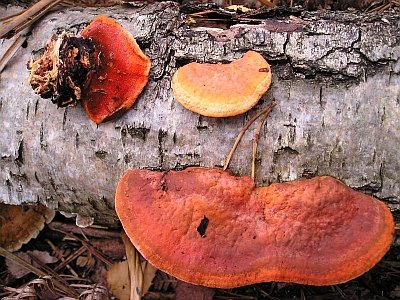
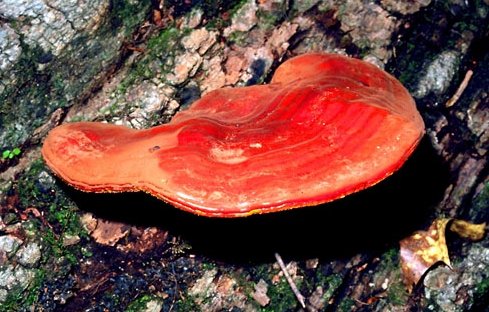
Fruiting body: 2-12 cm across, 2-8 cm wide, 0.5-2.0 cm thick, kidney or fan-shaped; leathery, becoming corky when dried; upper surface covered in fine soft hairs when young, giving them a pruinose appearance; later smooth and wrinkled, cinnabar -red or orange-red, color decreasing in intensity with age.
Tubes: 2-6 mm long, cinnabar red.
Pores: 2-4 per mm, round or angular, cinnabar-red.
Spores: white, oblong-ellipsoid, non-amyloid, 4.5-6 x 2-3 µm.
Spore print: white.
Habitat: lives on dead deciduous trees, especially cherry, beech and birch.
Season: summer and fall. Rare.
Edibility: not edible.
Distribution: America, Asia and Europe.
Medicinal Properties
Antibacterial efffects
The fruitbodies of Pycnoporus cinnabarinus were screened and found to possess antibacterial properties (Fajana et al., 1999). Shittu et al. (2005) examined mycelial growth and antibacterial metabolite production. The antibacterial activity (measured by the agar cup diffusion method) against B. subtilis was highest after four days of growth.
The concentrated culture fluid of P. cinnabarinus showed biological activity against a variety of bacterial strains, with maximal inhibitory effect for Gram-positive bacteria of the genus Streptococcus. P. cinnabarinus produces the phenoxazinone derivative, cinnabarinic acid, a red pigment that accumulates in fruit bodies as well as in liquid cultures. Laccase secreted by the fungus oxidizes the precursor 3-hydroxyanthranilic acid to cinnabarinic acid, a reaction that is necessary for the production of antibacterial compounds. The biological activity of concentrated P. cinnabarinus culture fluid was nearly identical with that of cinnabarinic acid, synthesized by purified laccase in vitro (Eggert, 1997).
In another study, the 20-day-old liquid culture filtrate of Pycnoporus cinnabarinus showed good antibacterial effects against the growth of the Gram-negative bacteria Escherichia coli and Pseudomonas aeruginosa as well as Gram-positive Staphylococcus aureus. The culture filtrate was also used against mycelial growth and mycelial weight of three plant pathogenic fungi Botrytis cinerea, Colletotrichum gloeosporioides [Glomerella cingulata] and Colletotrichum miyabeanus, showing good inhibitory effect (Imtiaj and Taesoo, 2007).
Anti-tumor effects
Polysaccharides extracted from the mycelial culture of P. cinnabarinus and administered intraperitoneally into white mice at a dosage of 300 mg/kg inhibited the growth of Sarcoma 180 and Ehrlich solid cancers by 90% (Ohtsuka et al., 1973).
My name is Austin Collins.
I've dedicated my life to Mushrooms.
I believe Mushrooms are the best kept secret when it comes to health and well being.
For that reason, I would like to share a company with you that in my opinion makes the best mushroom products on the market.
The company is called Noomadic Herbals, my favorite supplement they make is called "Mushroom Total".
I take their products every day and they have helped me think better and have more energy. Give them a try.
-Austin
References
Eggert C.
Laccase-catalyzed formation of cinnabarinic acid is responsible for antibacterial activity of Pycnoporus cinnabarinus.
Microbiol. Res. 1997 152(3):315-8.
Fajana OB, Alofe FV, Onawunmi GO, Ogundaini AO, Tiwalade TA.
Antimicrobial studies on Nigerian higher fungi.
Nigerian J Nat Prod Med. 1999 3:64-65.
Imtiaj A, TaeSoo L.
Screening of antibacterial and antifungal activities from Korean wild mushrooms.
World J Agric Sci. 2007 3(3):316-21.
Ohtsuka S, Ueno S, Yoshikumi C, Hirose F, Ohmura Y, Wada T, Fujii T, Takahashi E.
Polysaccharides having an anticarcinogenic effect and a method of producing them from species of Basidiomycetes.
UK Patent 1331513, 26 September 1973.
Shittu, OB, Alofe, FV,Onawunmi GO, Ogundaini AO, Tiwalade TA.
Mycelial growth and antibacterial metabolite production by wild mushrooms.
African J Biomed Res. 2005 8(3):157-62.
Bioline
Hello Mr Mushroom
I want to send you a pic to I.D. a tree funghi, please if you would be kind to me. I am almost sure it is Turkey Tail type (Pyncnoporus cinnabarinus) say this after a Guinness or 2.
I forage too in the forest, Porcini (Stein Pilze) Blushers, Pine Ring (Reitzger). Pine Nuts it goes on and on. When the shtf (it has, silly) I will eat like a Prince where all else are starving.