
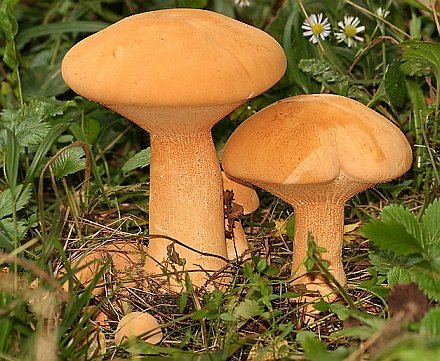
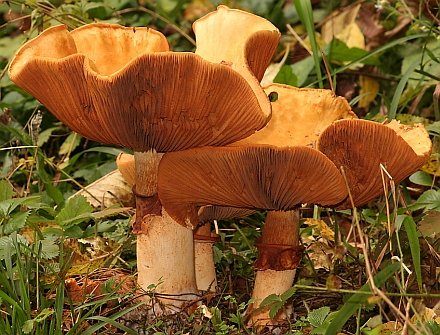
The golden bootleg mushroom, Phaeolepiota aurea (Matt.) Maire.
Synonyms
Agaricus aureus Matt.
Résult. Voy. Belgica, Lich.: 331 (1777)
Agaricus aureus var. herefordensis Cooke
Handbook of British Fungi, 2 ed.: 140 (1883)
Agaricus aureus var. vahlii (Schumach.) Cooke
Handbook of British Fungi, 2 ed.: 140 (1884)
Agaricus caperatus sensu Cooke
[Ill. Brit. Fung. 375 (348) Vol. 3 (1885)]; fide Checklist of Basidiomycota of Great Britain and Ireland (2005)
Agaricus spectabilis Fr.
Elench. fung. (Greifswald) 1: 28 (1828)
Agaricus vahlii Schumach.
Enum. pl. (Kjbenhavn) 2: 258 (1803)
Cystoderma aureum (Matt.) Kühner & Romagn.
Fl. Analyt. Champ. Supér. (Paris): 393 (1953)
Fulvidula spectabilis (Fr.) Romagn.
Revue Mycol., Paris 2: 191 (1937)
Gymnopilus spectabilis (Fr.) Singer
Nov. holland. pl. spec.: 471 (1951)
Lepiota pyrenaea Quél.
Assoc. Fr. Avancem. Sci. 16: 1 (1887)
Pholiota aurea (Matt.) Pers.
Syn. meth. fung. (Göttingen) 2: 269 (1801)
Pholiota aurea var. herefordensis (Cooke) Sacc.
Syll. fung. (Abellini) 5: 736 (1887)
Pholiota aurea var. vahlii (Schumach.) Sacc.
Syll. fung. (Abellini) 5: 736 (1887)
Pholiota caperata sensu Kummer
[Fuhr. Pilzk: 84 (1871)]; fide Checklist of Basidiomycota of Great Britain and Ireland (2005)
Pholiota spectabilis (Fr.) P. Kumm.
Führ. Pilzk. (Zwickau): 84 (1871)
Pholiota vahlii Weinm.
Rozites spectabilis (Fr.) Singer
(1922)
Togaria aurea (Matt.) W.G. Sm.
Syn. Brit. Basidiomyc.: 122 (1908)
Togaria aurea var. herefordensis (Renny) W.G. Sm.
Syn. Brit. Basidiomyc.: 122 (1908)
Togaria aurea var. vahlii (Schumach.) W.G. Sm.
Syn. Brit. Basidiomyc.: 122 (1908)
Togaria caperata sensu Smith (1908)
fide Checklist of Basidiomycota of Great Britain and Ireland (2005)
Common names
Golden bootleg
Golden cap
Golden false pholiota
Alaska gold
Goudhoed (Dutch)
Pholiota Dorée (French)
Glimmerschüppling (German)
Koganetake (Japanese)
Description
Cap: 7-20 cm wide (frequently attaining 30 cm diameter), rounded to convex or almost flat, with a central knob; color golden brown to orange-tan; surface dry and floccose–granulose; margin often fringed with veil remnants; flesh pallid whitish
Gills: adnate or with short decurrent tooth, close, pale yellow or rusty-golden color.
Stem: 10-20 cm high x 1.5-3 cm thick; enlarging downward to subclavate. Above the annulus it is smooth and glabrous, a lighter shade than the cap; under the ring concolorous and granulose; flesh light yellow, deepening in color when bruised or cut.
Universal veil: sheathes the stalk and becomes a hard persistent ring in the upper half of the stem; lower surface is striate.
Odor: resembling bitter almonds.
Taste: mild/slightly sweet.
Spores: 10-14 x 5-6 µm, elliptical, smooth, yellowish.
Spore print: light yellow-brown.
Habitat: gregarious or caespitose, on ground in deciduous and coniferous forests, along road edges (especially under Alder). Sept-Nov. Rare.
Edibility: edible for some, causes gastrointestinal disturbance in others (see Wells and Kempton, 1965). Contains hydrocyanic acid (HCN) (Heinemann, 1942).
Description adapted and modified from Stana, 1995 and Wells and Kempton, 1965.
Bioactive compounds
Lectins
Lectin activity with N-acetylgalactosamine specificity has been identified from an extract of P. aurea. Two lectins, PAL-I and PAL-II, both tetramers of 16 kDa subunits, showed slight preferences for type-A rather than type B and O erythrocytes (Kawagishi et al., 1996).
Medicinal properties
Antitumor effects
Polysaccharides extracted from the mycelial culture of P. aurea and administered intraperitoneally into white mice at a dosage of 300 mg/kg inhibited the growth of Sarcoma 180 and Ehrlich solid cancers by 100% (Ohtsuka et al., 1973).
My name is Austin Collins.
I've dedicated my life to Mushrooms.
I believe Mushrooms are the best kept secret when it comes to health and well being.
For that reason, I would like to share a company with you that in my opinion makes the best mushroom products on the market.
The company is called Noomadic Herbals, my favorite supplement they make is called "Mushroom Total".
I take their products every day and they have helped me think better and have more energy. Give them a try.
-Austin
Links
Mushroom the Journal’s article “Pholiolepiota aurea: a beautiful and mysterious mushroom”
BioPix has several pictures, as does this ‘Bisernica‘ website
Fungi of Poland
References
Benedict RG,l Brady LR, Stuntz DE.
Taxonomic status of Pholiota aurea.
Mycologia. 1972 64(5):1167-9.
Hatanaka S-I, Kawakami K, Ishida Y.
Biochemical studies on nitrogen compounds of fungi. 18. Isolation and identification of gamma-L glutamyl-beta alanine from Phaeolepiota aurea.
Scientific Papers of the College of General Education University of Tokyo (Biological Part). 1979 29(2):155-8.
Kawagishi H, Wasa T, Murata T, Usui T, Kimura A, Chiba S.
Two N-acetyl-D-galactosamine-specific lectins from Phaeolepiota aurea.
Phytochem. 1996 41(4):1013-6.
Ohtsuka S, Ueno S, Yoshikumi C, Hirose F, Ohmura Y, Wada T, Fujii T, Takahashi E.
Polysaccharides having an anticarcinogenic effect and a method of producing them from species of Basidiomycetes.
UK Patent 1331513, 26 September 1973.
Stana D.
Data regarding the spreading of the Phaeolepiota aurea (Matt.:Fr.) Mre. species in Romania.
Not Bot Hort Agrobot Cluj. 1995 24-25:23-26.
Wells VL, Kempton PE.
Togaria aurea in Alaska.
Mycologia. 1965 57(2):316-8.