
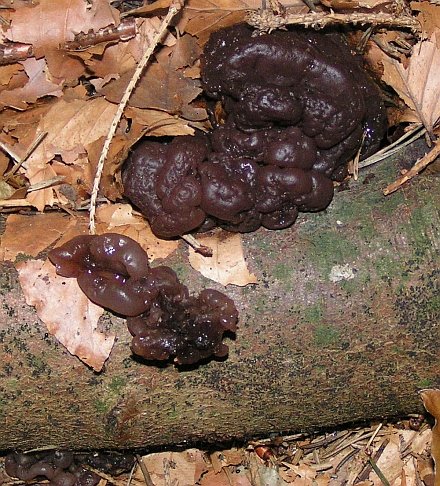
Black witches’ butter, Exidia glandulosa (Bull.) Fr.
Classification
Kingdom Fungi
Phylum Basidiomycota
Class Basidiomycetes
Order Tremellales
Family Exidiaceae
Genus Exidia
Synonyms
Exidia intumescens sensu auct.
fide Checklist of Basidiomycota of Great Britain and Ireland (2005)
Exidia plana sensu auct.
fide Checklist of Basidiomycota of Great Britain and Ireland (2005)
Exidia spiculosa (Pers.) Sommerf.
Suppl. Fl. lapp. (Oslo) (1826)
Gyraria spiculosa (Pers.) Gray
Nat. Arr. Brit. Pl. (London) 1: 594 (1821)
Tremella arborea sensu auct.
fide Checklist of Basidiomycota of Great Britain and Ireland (2005)
Tremella atra Fr.
Fl. Danic. 5: tab. 884 (1782)
Tremella glandulosa Bull.
Herbier de la France 9: tab. 420, fig. 1 (1789)
Tremella intumescens sensu auct.
fide Checklist of Basidiomycota of Great Britain and Ireland (2005)
Tremella spiculosa Pers.
Observ. mycol. (Lipsiae) 1: 99 (1796)
Common names
Black witch’s butter
Black jelly roll
Warty jelly fungus

My name is Austin Collins.
I've dedicated my life to Mushrooms.
I believe Mushrooms are the best kept secret when it comes to health and well being.
For that reason, I would like to share a company with you that in my opinion makes the best mushroom products on the market.
The company is called Noomadic Herbals, my favorite supplement they make is called "Mushroom Total".
I take their products every day and they have helped me think better and have more energy. Give them a try.
-Austin
Description
In a 150-year old treatise on English botany, (Sowerby et al., 1846, p. 225) it is mentioned that according to Dillenius, this species earned its common name “witches’ butter” because it was believed to be useful against witchcraft when thrown into a fire.
Fruiting body: wrinkled, gelatinous; beginning as a pallid or translucent blister but soon becoming cushion-shaped to irregularly lobed, appearing effused, undulate, brain-like in structure; usually dark black color, but sometimes reddish black to olive-black in younger specimens; 1-2 cm broad but often fusing with adjacent sporophores to form extensive patches; upper surface smooth to minutely roughened with scattered, erect, short spicules.
Flesh: gelatinous, black.
Taste, smell: indistinct.
Spore print: whitish; the spores are borne on the lobes, warts or wrinkles.
Spores: 10-16 x 3-5 µm, allantoid, smooth.
Edibility: unclear (different opinions depending on the source).
Habitat: found on dead wood of deciduous trees, especially birch, beech, alder, pine, hawthorn. It prefers cooler temperatures and is more likely to be found Sept to May.
The fruiting body will dehydrate to form a thin membrane, but will rehydrate when moistened. The fruiting bodies are somewhat translucent when young and fresh.
Lipid composition
The lipid composition of E. glandulosa is 37.5% total lipids (mg/g dry weight). Of this total, 60.5% is neutral lipids, 35.8% is phospholipids and 3.7% glycolipids (Dembitsky et al., 1992). Further details about the particulars of lipid composition in this species can be found in that reference and in Demibitsky et al., 1993.
Medicinal properties
Antitumor effects
Polysaccharides extracted from the mycelial culture of E. glandulosa and administered intraperitoneally into white mice at a dosage of 300 mg/kg inhibited the growth of Sarcoma 180 and Ehrlich solid cancers by 100% and 90%, respectively (Ohtsuka et al., 1973).
Links
California Fungi, the Fungi on Wood site, and Biolib all have more photos or descriptions.
References
Dembitsky VM, Rezanka T, Shubina EE.
Chemical composition of fatty acids from some fungi
Crypt Bot. 1993 3(4):383-6.
Dembitsky VM, Shubina EE, Kashin AG.
Phospholipid and fatty acid composition of some basidiomycetes.
Phytochem. 1992 31(3):845-9.
Ohtsuka S, Ueno S, Yoshikumi C, Hirose F, Ohmura Y, Wada T, Fujii T, Takahashi E.
Polysaccharides having an anticarcinogenic effect and a method of producing them from species of Basidiomycetes.
UK Patent 1331513, 26 September 1973.