
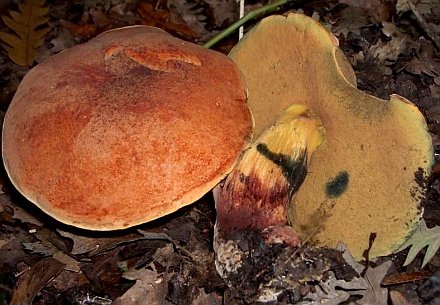
The deceiving bolete, Boletus queletii Schulzer.
Classification
Kingdom Fungi
Phylum Basidiomycota
Class Basidiomycetes
Order Boletales
Family Boletaceae
Genus Boletus
Synonyms
Boletus erythropus sensu Persoon [Syn. Met. Fung.: 513 (1801)]
fide Checklist of Basidiomycota of Great Britain and Ireland (2005)
Boletus lateritius Bres. & Schulzer
Boletus queletii var. lateritius (Bres. & Schulzer) E.-J. Gilbert
118 (1931)
Boletus queletii var. rubicundus Maire
Bull. Soc. mycol. Fr. 26: 195 (1910)
Tubiporus queletii (Schulzer) Imler
(1956)
Tubiporus queletii (Schulzer) Imler ex S. Ahmad, Biologia
Lahore 8(2): 125 (1962)
Common names
Deceiving bolete
Bolet de Quélet (French)
Glattstieliger Hexenröhrling (German)
Borowik gładkotrzonowy (Polish)
Description
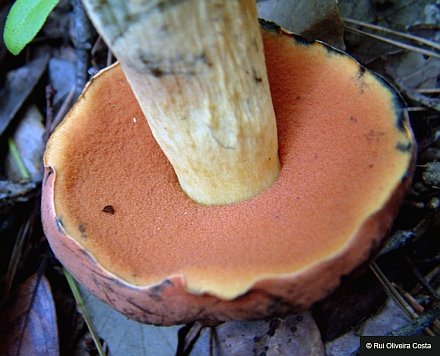
Cap: 5-20 cm diameter, hemispherical to convex, orange brick to cinnamon brown color, tomentose or glabrous, bruising blackish blue.
Pores: surface orange or peach, bruising blackish blue/green; tubes 5-6 mm long, yellow, minute, less than 0.5 mm across.
Stem: 5-10 long x 3-5 cm thick, subequal or bulbous, often tapered abruptly towards the base; yellow at apex then reddish or somewhat orange, becoming progressively darker downwards, bruising blue. Somtimes slightly reticulate with red veins on the upper part. Flesh lemon yellow in cap and upper part of stem, purplish red in stem base, blue or greenish blue when cut.
Spores: olivaceous, elliptical, 10-16 x 5-7 µm.
Edibility: edible.
Habitat: on grounds in deciduous woods, often associated with Fagus, Quercus and Tilia species.
Medicinal properties
Antimalarial activity
Water extracts of B. queletii inhibit the growth of the pyrimethamine-resistant malarial parasite Plasmodium falciparum (Lovy et al., 1999). The inhibitory effect was 1.1% (measured as inhibition per µg protein/ml extract) of that of the water extract of the most inhibitory anti-malarial species tested, Polyporus umbellatus.
My name is Austin Collins.
I've dedicated my life to Mushrooms.
I believe Mushrooms are the best kept secret when it comes to health and well being.
For that reason, I would like to share a company with you that in my opinion makes the best mushroom products on the market.
The company is called Noomadic Herbals, my favorite supplement they make is called "Mushroom Total".
I take their products every day and they have helped me think better and have more energy. Give them a try.
-Austin
Links
References
Chiu WF.
The boletes of Yunnan.
Mycologia. 1948 40(2):199-231.
Colak, A, Kolcuoglu, Y, Sesli, E, Dalman, O.
Biochemical composition of some Turkish fungi.
Asian J Chem. 2007 19(3):2193-9.
Heykoop, M.
Morphology and taxonomy of Boletus queletii var Discolor, a rare bolete resembling Boletus erythropus.
Mycotaxon. 1995 56:115-23.
Lovy A, Knowles B, Labbe R, Nolan L.
Activity of edible mushrooms against the growth of human T4 leukemic cancer cells, HeLa cervical cancer cells, and Plasmodium falciparum.
J Herbs Spices Med Plants. 1999 6(4):49-58.
I have these in my yard in central Florida. Are they edible?
If they are Boletus queletii, they are edible. Lots of mushrooms look alike, make sure you are identifying it correctly. Preferably ask a mycologist in your area.