
Classification
Kingdom Fungi
Phylum Basidiomycota
Class Basidiomycetes
Order Boletales
Family Boletaceae
Genus Boletus
Synonyms
Bolbitius vitellinus var. variicolor (G.F. Atk.) Krieglst.
Beitr. Kenntn. Pilze Mitteleur. 7: 62 (1991)
Common name
None
Description
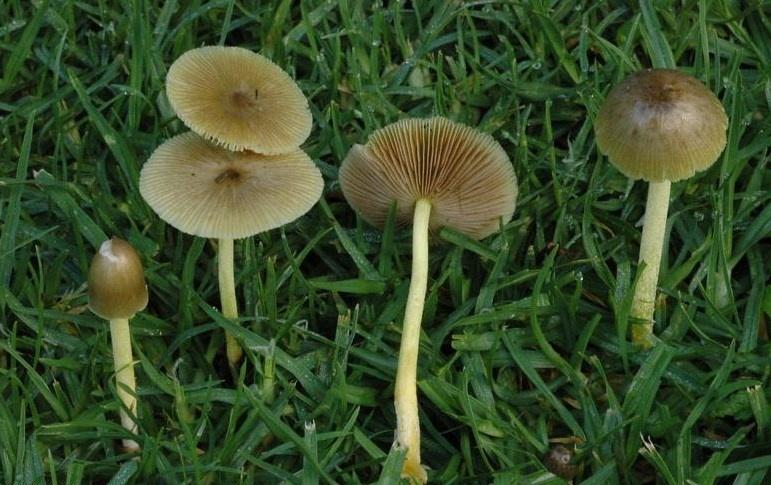
Cap: 1-3 cm, broadly conical or campanulate, chrome-yellow when young, fading with age, especially at the margins; smooth, viscid when young but can become varnished in drier conditions; margin even, striate.
Flesh: yellowish, very thin.
Gills: adnexed or free, pale yellow becoming rusty brown.
Stem: 3-9 x 0.2-0.4 cm, cylindrical, white or pale yellow, hollow, usually covered with a fine, mealy coating and with white floccules at the base, dry.
Spore print: rust brown.
Spores: yellowish, 11-16 x 6-9 µm, truncate-ellipsoid with a large germ pore at the truncate end, smooth, light brown.
Habitat: grows on manure, on grass, in summer and fall; common.
Description adapted from Young et al., 2004, p. 114
Medicinal properties
Antitumor activity
Polysaccharides extracted from the mycelial culture of B. variicolor and administered intraperitoneally into white mice at a dosage of 300 mg/kg inhibited the growth of Sarcoma 180 and Ehrlich solid cancers by 60% (Ohtsuka et al., 1973).
My name is Austin Collins.
I've dedicated my life to Mushrooms.
I believe Mushrooms are the best kept secret when it comes to health and well being.
For that reason, I would like to share a company with you that in my opinion makes the best mushroom products on the market.
The company is called Noomadic Herbals, my favorite supplement they make is called "Mushroom Total".
I take their products every day and they have helped me think better and have more energy. Give them a try.
-Austin
Links
A gallery of pictures can be viewed at the German website Pilzgalerie.
References
Ohtsuka S, Ueno S, Yoshikumi C, Hirose F, Ohmura Y, Wada T, Fujii T, Takahashi E.
Polysaccharides having an anticarcinogenic effect and a method of producing them from species of Basidiomycetes.
UK Patent 1331513, 26 September 1973.
Young T, Young AM, Smith K. (2004).
A Field Guide to the Fungi of Australia.
USNW Pres, 240 pp.
Google book preview